
At its very heart, moissanite is a compound called silicon carbide (SiC). This simple but powerful combination is what gives the gemstone its incredible durability and that fiery sparkle it’s famous for. Believe it or not, the first moissanite wasn't found in the earth, but in a meteorite crater—it’s quite literally a gem born from the stars.
A Gem Born from Stars
The story behind moissanite isn't one of deep-earth geology. Instead, it’s a story written in the cosmos, involving interstellar travel and a fiery impact that adds a unique layer of romance and wonder to this exceptional gem.
The Cosmic Origins of Silicon Carbide
Think about a material forged in dying stars, traveling across the vastness of space for eons before landing on our planet. That’s the real story of natural moissanite. Back in 1893, a French chemist named Henri Moissan was examining rock samples from a massive meteorite crater in Arizona when he stumbled upon tiny, glittering crystals.
He initially thought they were diamonds, but further analysis proved it was a completely new mineral. The chemical recipe for moissanite is a precise blend of 70.04% silicon and 29.96% carbon by weight. This specific composition, first identified by Moissan himself, is the key to the stone’s incredible properties. You can actually dig into the initial discovery analysis on Webmineral.com to see the original data.
For a quick overview, here's a snapshot of moissanite's core profile.
Moissanite at a Glance Chemical and Physical Profile
| Property | Description |
|---|---|
| Chemical Formula | SiC (Silicon Carbide) |
| Crystal System | Hexagonal |
| Mohs Hardness | 9.25 (Extremely durable) |
| Refractive Index | 2.65 - 2.69 (Higher than diamond, causing more fire) |
| Origin | Naturally occurring in meteorites; commercially lab-grown |
This table highlights just why silicon carbide is such a remarkable material for jewelry.
From Natural Rarity to Lab Perfection
While its cosmic origin story is captivating, natural moissanite is mind-bogglingly rare. It's so scarce, in fact, that finding a naturally occurring crystal large enough to be cut into even a tiny gemstone is virtually impossible. This extreme rarity is what pushed scientists to figure out how to grow it here on Earth.
Today, almost every moissanite you'll find in jewelry was meticulously grown in a laboratory. This process doesn't just replicate nature; it perfects it, allowing for the creation of large, flawless crystals with stunning clarity and color. This approach brings some huge benefits to the table:
- Ethical Sourcing: Lab creation completely sidesteps the environmental and ethical issues tied to traditional gemstone mining.
- Consistent Quality: Every single stone can be grown to meet precise standards, guaranteeing you get maximum brilliance and fire.
- Accessibility: Growing moissanite in a lab makes this incredible gem available at a price point that's much more approachable than other rare jewels.
It's important to remember that moissanite isn't a "fake" diamond. It's a genuine gemstone in its own right, with its own unique chemical structure and, in many ways, superior optical properties. Being lab-grown simply makes its beauty accessible to all.
This modern, scientific approach means the moissanite you wear isn't just beautiful—it's a product of human ingenuity and ethical consideration. It truly carries the legacy of the stars, perfected for a lifetime of brilliance.
From Meteorite Craters to Modern Labs
The story of moissanite is a fascinating blend of cosmic chance and human ingenuity. It all started back on December 28, 1892, when a French Nobel Prize winner, Henri Moissan, was examining mineral fragments from the Canyon Diablo meteorite crater. He initially mistook the tiny, shimmering crystals for diamonds, but soon realized he’d discovered something entirely new: natural silicon carbide.
These bits of stardust, however, were incredibly rare. Even the largest natural moissanite crystals found are smaller than 1mm—far too tiny and scarce to ever be used in jewelry. For the better part of a century, this cosmic mineral remained little more than a scientific curiosity. The cosmic origin of moissanite is a story that truly began in space.
Engineering Brilliance in the Lab
The real game-changer came when scientists figured out how to grow silicon carbide crystals in a lab. This synthesis process essentially recreates the intense heat and pressure that formed the original moissanite, but with a level of control that nature can't match. Think of it as cultivating a perfect orchid in a state-of-the-art greenhouse instead of hoping to find one in a remote jungle.
It’s this lab-grown process that makes the beautiful moissanite gems we see today possible. And to be clear, these aren't "fakes" or imitations; they are chemically and physically the exact same material as the crystals found in meteorites, just made by us. This meticulous method also ensures every gemstone is free of the internal flaws and inclusions common in mined stones, leading to breathtakingly consistent clarity and fire.
The ability to grow moissanite in a lab transformed it from a mineralogical rarity into a celebrated gemstone. It guarantees an ethical, conflict-free source while delivering exceptional quality.
Modern production techniques have taken this process to a whole new level. While Edward Acheson first synthesized silicon carbide (which he called carborundum) back in 1891, it took decades to refine the method for creating true gem-quality crystals for the jewelry market. Today, manufacturers can grow flawless moissanite in large batches, making this once-celestial gem accessible to everyone. It’s a remarkable scientific achievement that lets us enjoy its fiery sparkle in engagement rings and fine jewelry.
Why Moissanite Has Such Dazzling Sparkle
That incredible sparkle you see in moissanite isn't some kind of trickery or magic—it's pure physics. It all comes down to its unique composition of silicon carbide. The specific way silicon and carbon atoms bond and arrange themselves creates a gemstone that plays with light in a way few others can, resulting in a fiery, brilliant flash that often outshines even a diamond.
To really get it, you need to know about two key optical properties: brilliance and fire. Think of brilliance as the pure white light a gem reflects back to your eye—its classic sparkle. Fire, on the other hand, is the dazzling rainbow of colors that flashes out as the gem splits light apart.
Bending Light for Maximum Brilliance
A gemstone's brilliance is all about its refractive index (RI), which is just a fancy way of saying how much it bends light. Imagine looking into a crystal-clear swimming pool; objects at the bottom look a bit warped because the water is bending the light. Moissanite has an exceptionally high refractive index, so it bends light far more dramatically than most other gems.
This intense light-bending power means that more of the light that enters the stone gets bounced back out to you instead of just passing through the bottom. The result? An absolutely stunning, bright sparkle that lights up from every angle. It's a direct consequence of what moissanite is made of—that silicon carbide structure is just built to redirect light.
You can dive deeper into how moissanite sparkles in different lighting conditions in our detailed guide.
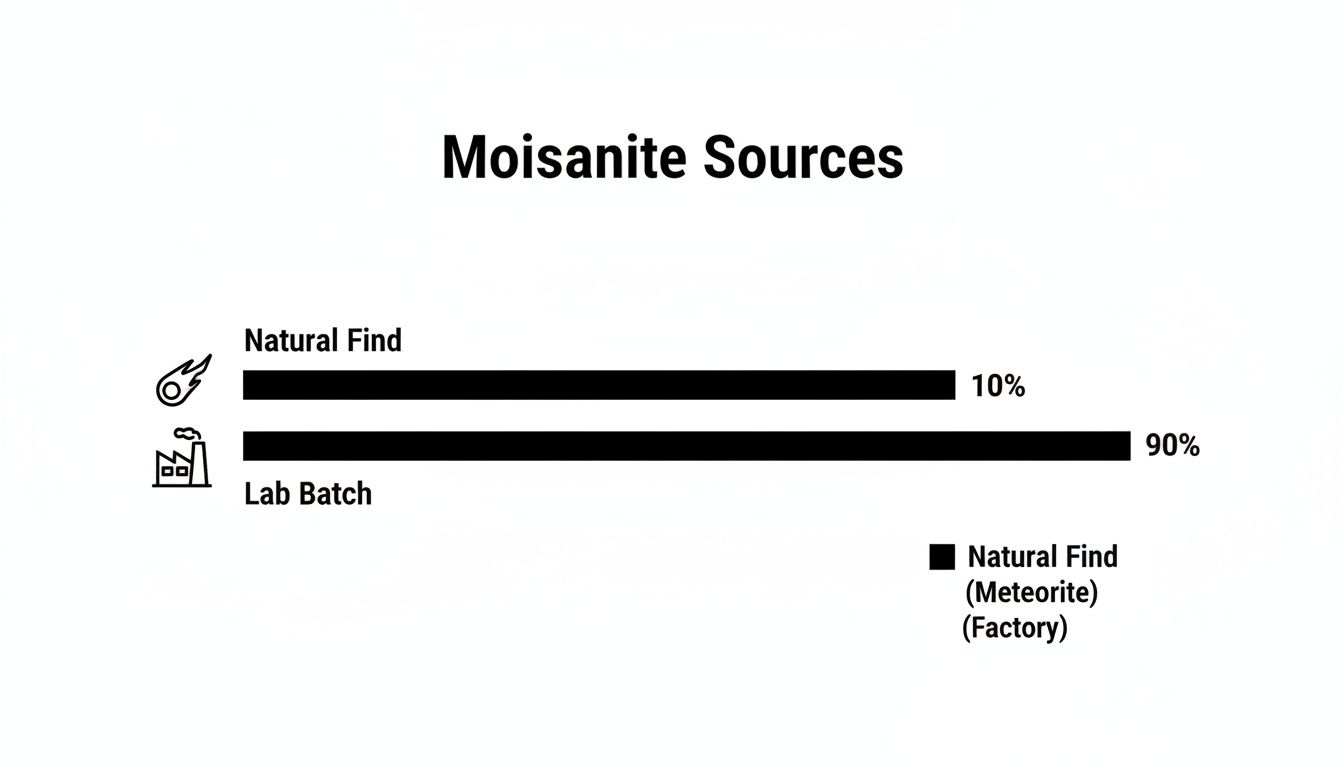
This visual makes it clear that lab-grown moissanite dominates the market, which is great news for anyone looking for consistent quality and an ethical choice.
Unleashing a Rainbow of Fire
Now, here's where moissanite really shows off. Its incredible fire is a property measured by a stone’s dispersion rating. If you've ever seen a prism turn a beam of sunlight into a full-blown rainbow, you've seen dispersion in action. Moissanite acts like a perfectly cut little prism, shattering white light into an unforgettable display of colorful flashes.
In fact, moissanite's dispersion rating is more than double that of a diamond. This is what creates that signature "disco-ball" effect, especially in sunlight or under bright lights. While a diamond offers a crisp, balanced sparkle, moissanite brings a much more intense and colorful light show to the party.
This exceptional fire isn't a flaw; it's one of the defining features of moissanite's silicon carbide structure. It's also one of the main reasons so many people fall in love with its dynamic personality.
Here are the key takeaways on moissanite's optical performance:
- Its refractive index reaches up to 2.69, significantly higher than diamond’s 2.42, creating superior brilliance.
- Its dispersion is a massive 0.104, more than twice diamond’s 0.044, which is why it has so much more colorful fire.
- Today, over 99.9% of all moissanite is created in a lab, with jewelers using over 1 million carats every year.
Optical Properties Moissanite vs Diamond vs Cubic Zirconia
To put it all into perspective, here’s a clear side-by-side comparison of moissanite against two other popular white gemstones. This table helps visualize how the numbers translate into real-world sparkle.
| Property | Moissanite (SiC) | Diamond (C) | Cubic Zirconia (ZrO2) |
|---|---|---|---|
| Brilliance (Refractive Index) | 2.65 - 2.69 | 2.42 | 2.15 - 2.18 |
| Fire (Dispersion) | 0.104 | 0.044 | 0.058 - 0.066 |
| Luster (Shine) | Adamantine to Metallic | Adamantine | Sub-Adamantine |
As the numbers clearly show, moissanite is the front-runner in both brilliance and fire. This data confirms its reputation as one of the most visually stunning and exciting gemstones you can find today.
The Durability of Silicon Carbide Explained
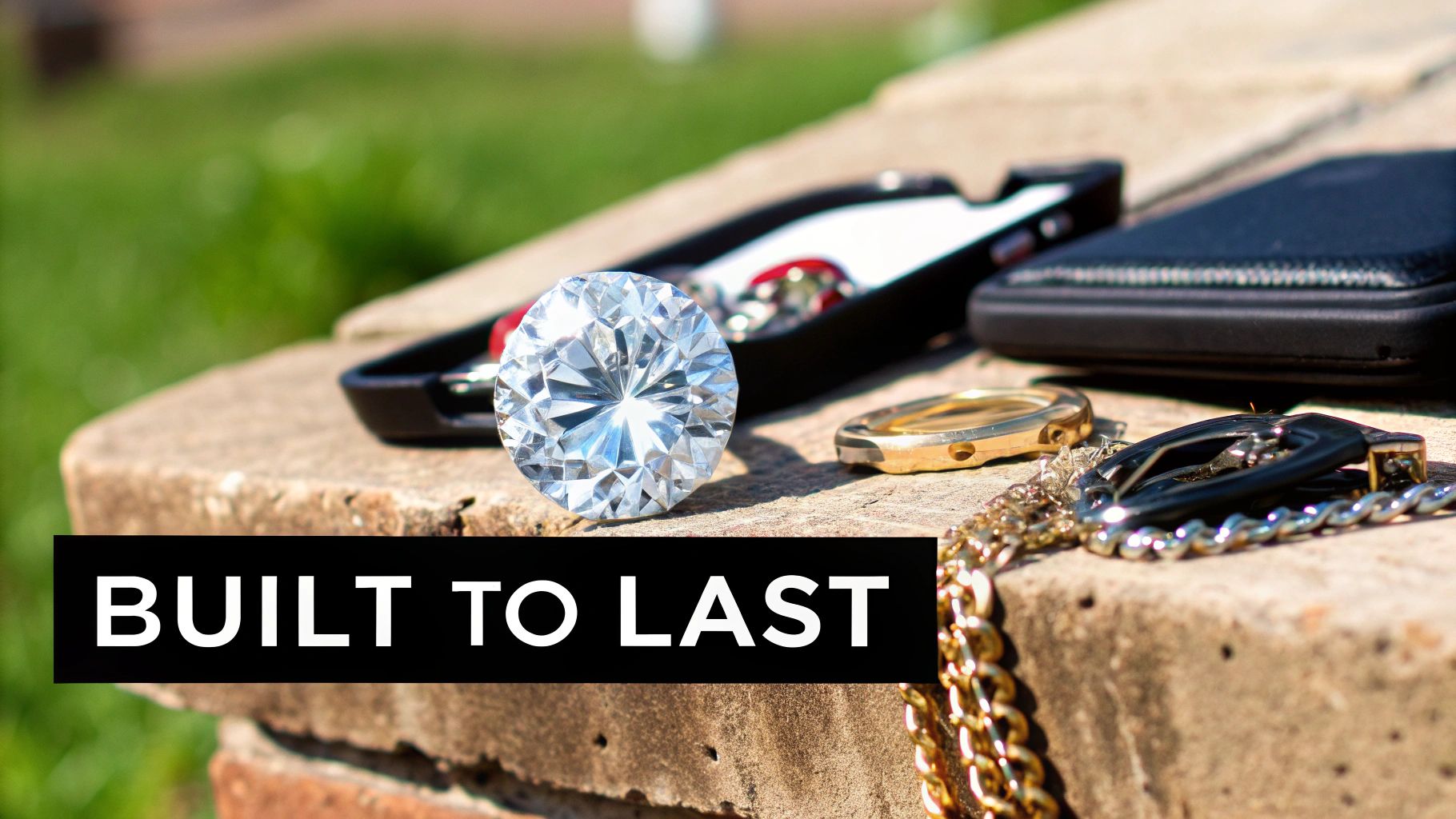
While moissanite’s incredible sparkle is what first catches the eye, it’s the rugged strength of its silicon carbide composition that truly makes it a fantastic choice for everyday jewelry. After all, a gemstone’s beauty means little if it can't handle the bumps and scrapes of daily life. This is where moissanite really shines.
Its durability isn't just a marketing claim; it's baked right into its atomic structure. The powerful covalent bonds holding the silicon and carbon atoms together create an extremely rigid and stable crystal lattice. Think of it like a chain where every single link is welded shut, making it nearly impossible to pull apart. That’s the kind of resilience you get with silicon carbide.
Built to Resist Scratches and Abrasions
This tight-knit structure translates directly into exceptional hardness. On the Mohs scale, which measures a mineral's ability to resist scratches, moissanite scores a remarkable 9.25.
This puts it right behind diamond, the undisputed king at a perfect 10, but comfortably ahead of other tough gems like sapphires (9) or emeralds (7.5-8).
So, what does that mean for an engagement ring? It means your moissanite will easily fend off scratches from accidental encounters with countertops, keys, and door frames. This incredible scratch resistance ensures the stone's surface stays smooth and its sparkle remains dazzling for years to come.
A gemstone's hardness is its best defense against the gradual dulling caused by tiny, microscopic scratches. With a Mohs rating of 9.25, moissanite is built to keep its fiery, pristine look through decades of wear.
Toughness Beyond Hardness
It’s easy to confuse hardness with toughness, but they’re two different things. Hardness is about resisting scratches, while toughness is a gem's ability to withstand chipping or breaking from an impact. A material can be very hard but also brittle.
Moissanite, however, is exceptionally tough. Once again, we can thank the strong bonds in its silicon carbide structure. It handles accidental knocks and bumps far better than more fragile gemstones might.
This one-two punch of hardness and toughness is what makes moissanite so dependable for jewelry you plan to wear all the time. It’s also incredibly stable when exposed to high temperatures—its heat tolerance is even greater than a diamond's. This means it won't be damaged by a jeweler’s torch during routine resizing or repairs.
Learning how to care for your moissanite jewelry is straightforward precisely because the stone itself is so resilient.
Ultimately, the science behind what moissanite is made of confirms its place as a "forever" stone. Its silicon carbide composition delivers the peace of mind that you don’t have to compromise on durability to get stunning brilliance at a great value.
The Ethical Choice of Lab Grown Gems
Beyond its incredible fire and rock-solid durability, moissanite’s origin story is one of its most compelling features. Every single moissanite used in jewelry today is born in a highly controlled lab setting, which means it completely sidesteps the ethical and environmental baggage that can come with mined gemstones.For a growing number of people, where a product comes from matters just as much as what it is. Lab creation offers total peace of mind—no ecosystems were disturbed, no earth was moved, and no local water supplies were contaminated. It's a clean, modern way to own a truly stunning gem without the environmental footprint.
The human element is just as crucial. With a lab-grown gem, the supply chain is transparent and completely conflict-free. You can be 100% certain your moissanite was created in a safe environment, free from the human rights issues that have cast a shadow over parts of the diamond trade for decades.
Smart Economics for a Smarter Purchase
This modern method of creation also brings a fantastic financial upside. Moissanite is significantly more accessible than a mined diamond of comparable size and clarity, typically costing just a fraction of the price.
This isn't a reflection of quality; it's a reflection of efficiency. The savings come from a streamlined, scientific process that avoids the massive overhead of traditional mining—think exploration, heavy machinery, and a long, complex supply chain.
By choosing a lab-grown gemstone like moissanite, you are investing in scientific innovation and ethical production. It allows you to get a larger, more brilliant stone without compromising your values or your budget.
This opens up a world of possibilities for buyers. You can finally design the ring you’ve always dreamed of, with the ideal size and cut, without the financial pressure. That means more of your budget is freed up for a wedding, a down payment, or any other life goal. When making an ethical gift choice, especially for significant items like jewelry, it can be helpful to consult comprehensive gift guides to explore all your options.
In the end, choosing moissanite is more than just an aesthetic or financial decision. It’s a statement that reflects modern values, proving that you don't have to sacrifice beauty or durability to make a responsible choice.
Common Questions About Moissanite
Even after digging into the science of what moissanite is—silicon carbide—you probably have a few practical questions. Let's walk through the most common ones so you can feel completely confident about this incredible gemstone.
Is Moissanite a Fake Diamond?
Absolutely not. Calling moissanite a "fake" diamond is like calling a sapphire a "fake" ruby. They are two entirely different, genuine gemstones, each with its own unique identity.
Moissanite is silicon carbide, not carbon. While it looks strikingly similar to a diamond at first glance, its fiery brilliance and incredible durability are all its own. It's a beautiful, resilient jewel that stands proudly on its own merits.
Will Moissanite Last Forever?
Yes, moissanite is absolutely built to last a lifetime. On the Mohs scale of hardness, it scores a 9.25, making it one of the toughest gemstones on Earth, second only to diamond.
What does that mean for you? It means your moissanite ring will strongly resist scratches, chips, and the general wear and tear of daily life. Its stable chemical structure won’t break down or lose its sparkle, making it a perfect choice for an engagement ring you’ll wear forever.
Moissanite's durability isn't just a talking point; it's a promise. The stone is engineered to maintain its stunning clarity and fire through decades of daily activities, ensuring your jewelry remains as brilliant as the day you first wore it.
Does Moissanite Get Cloudy Over Time?
Nope, never. A high-quality moissanite will not become cloudy or dull on its own. Its crystal structure is permanent and doesn't change with age or exposure to the elements.
If you ever notice your stone looking a bit less brilliant, it's just a surface-level issue. Everyday grime, lotions, and natural skin oils can build up on any gemstone. A quick, gentle cleaning with a soft brush and some soapy water will bring its signature fire right back to life.
How Is Colored Moissanite Made?
Creating those beautiful, vibrant colors in moissanite is a fascinating process that happens right in the lab. There are a few different techniques jewelers and scientists use:
- Intrinsic Coloration: This method involves introducing trace elements during the crystal's actual growth phase. For example, adding a bit of nitrogen can yield a yellow or green hue, while boron can create stunning blues. The color becomes part of the stone itself.
- Structural Changes: Sometimes, colors like pink or red are achieved by inducing tiny, controlled changes in the crystal's lattice structure as it forms.
- Surface Coating: A thin but very durable layer of color can be applied to the pavilion (the bottom part) of a finished moissanite. This is often done using a process called Chemical Vapor Deposition (CVD), and the result is a tough, permanent coating.
These advanced methods open up a whole rainbow of possibilities for moissanite jewelry.
Can You Tell the Difference Between Moissanite and Diamond?
For the average person, telling a moissanite from a diamond side-by-side is incredibly difficult. They are both beautiful, clear, and sparkling gemstones. However, there is one giveaway for a trained eye: the fire.
Moissanite has a much higher refractive index, which means it bends light more dramatically. The result is more intense and colorful flashes of light—what some people call the "disco-ball effect." This rainbow sparkle is especially noticeable in larger stones or under bright, direct light. A jeweler will spot it right away, but most people you meet won't have a clue.
Ultimately, moissanite’s role as a stunning, ethical gem is what matters most, and how it’s presented through compelling jewelry product photography has been key to its growing popularity.
Ready to see the brilliant, ethical beauty of moissanite for yourself? Explore the stunning, handcrafted collections at Moissanite Diamond and find the perfect piece that combines timeless design with modern values.