
For a standard piece like an engagement ring, you can expect the rhodium plating cost to fall somewhere between $60 and $150. Of course, that's just a ballpark. The final price tag hinges on a few key things: the size and intricacy of your jewelry, and the ever-changing market price of rhodium itself—one of the priciest precious metals on the planet.
What Exactly Is Rhodium Plating and Why Is It So Expensive?
Think of rhodium plating less as a material and more as a high-tech suit of armor for your favorite jewelry. Your ring isn't made of rhodium; instead, it gets a super-thin, protective layer of it applied over the base metal, which is usually white gold or sterling silver. This electroplating process is what gives your jewelry that stunning, crisp, mirror-like white finish that’s as durable as it is beautiful.
A good analogy is the clear coat on a car. It doesn't change the car's color or build, but it adds that glossy sheen and protects the paint underneath from scratches and the elements. Rhodium plating does the exact same job for your jewelry.
The Real Reason Behind the High Cost
So, why the hefty price tag? It boils down to one simple fact: rhodium is incredibly rare and valuable. It's part of the platinum family of metals and is one of the scarcest elements found in the Earth's crust. Its price isn't just high; it's famously volatile, often rocketing past the price of gold and even platinum.
Rhodium's immense value is fueled by a perfect storm of scarcity and demand. It's much rarer than gold, and most of the world's supply gets snapped up by the auto industry for catalytic converters. That leaves very little for the rest of us, including jewelers.
This dynamic creates some wild price swings. To put it in perspective, in August 2021, rhodium hit a staggering peak of over $19,000 per ounce when gold was hovering around $1,800. That made it more than ten times more expensive. Even in July 2023, it was trading at $15,250 per troy ounce, cementing its status as a top-tier precious metal. You can find more details on rhodium's extreme value at callagold.com. This market reality directly impacts what your jeweler has to pay for the rhodium solution, and that cost ultimately gets passed on to you.
The price you pay isn't just for a quick dip in a rhodium bath. It's a multi-step process that requires a skilled hand to get right.
Here's a breakdown of the primary factors that influence what you'll end up paying.
Key Factors That Influence Rhodium Plating Cost
| Cost Factor | Typical Impact on Price | Example |
|---|---|---|
| Jewelry Size | Moderate: Larger pieces require more rhodium solution and time. | Plating a wide men's wedding band will cost more than a delicate woman's ring. |
| Design Complexity | High: Intricate designs with crevices or detailed metalwork take longer to prepare and plate evenly. | A filigree or pavé-set ring is more complex to plate than a simple solitaire. |
| Current Rhodium Price | Very High: As a commodity, rhodium's market price fluctuates daily, directly affecting the cost of the service. | A price spike in the rhodium market can increase plating costs across the board, even overnight. |
| Geographic Location | Moderate: Labor costs and overhead vary significantly between major metropolitan areas and smaller towns. | A jeweler in New York City will likely charge more than one in a small midwestern town for the same service. |
| Jeweler's Expertise | Moderate: Highly reputable jewelers with specialized equipment and experience may charge a premium for their work. | A master jeweler known for high-quality restoration work may have higher rates. |
| Initial Condition | Low to Moderate: If a ring is heavily scratched or damaged, it will require more prep work (polishing, repairs) before it can be plated. | A ring that's been worn daily for 10 years will need more prep than one that's a year old. |
Ultimately, the rhodium plating cost is a fair reflection of rare materials, specialized equipment, and the professional skill needed to bring your jewelry back to life. It's truly an investment in restoring its original brilliance and strength.
What Does Rhodium Plating Actually Cost?
So, what should you realistically expect to pay to get your favorite ring looking brand new again? For a professional replating service on a standard ring, you're typically looking at a range between $60 and $120.
That price isn't just for a quick dunk in a rhodium bath. It covers the entire process: a thorough deep cleaning, expert polishing to remove any existing scratches, and the careful application of the rhodium layer itself. The goal is to bring back that stunning, mirror-like shine you fell in love with.
Of course, the final price tag really comes down to the piece of jewelry. A simple, smooth wedding band is one thing, but an intricate engagement ring with delicate metalwork and a constellation of tiny stones is a whole different ballgame. Those complex designs require a jeweler's steady hand and extra time to ensure the rhodium is applied perfectly without touching or damaging the gemstone settings.
Breaking Down the Cost by Jewelry Type
The biggest factor influencing your final bill is, without a doubt, the type of jewelry you're having plated. Different pieces come with their own unique challenges, from the sheer surface area that needs to be covered to the complexity of the design.
To give you a clearer picture, here’s a quick breakdown of what you might expect to pay for different items.
Estimated Rhodium Plating Costs by Jewelry Type
| Jewelry Type | Average Cost Range | Key Considerations |
|---|---|---|
| Simple Rings (e.g., Wedding Bands) | $60 – $80 | Their smooth, uninterrupted surfaces make them the easiest and quickest to clean, polish, and plate evenly. |
| Engagement & Complex Rings | $90 – $150+ | Intricate details like pavé settings, filigree, or multiple stones require far more time and precision from the jeweler. |
| Other Jewelry (e.g., Earrings, Pendants) | $75 and up | Costs here can vary widely. A small pair of stud earrings will be on the lower end, while a large, detailed pendant will cost more. |
This table should help you ballpark the cost, but always remember to get a direct quote from your jeweler for your specific piece.
The high price of the service makes a lot more sense when you see how valuable the raw material is. Rhodium is one of the rarest and most expensive precious metals in the world.
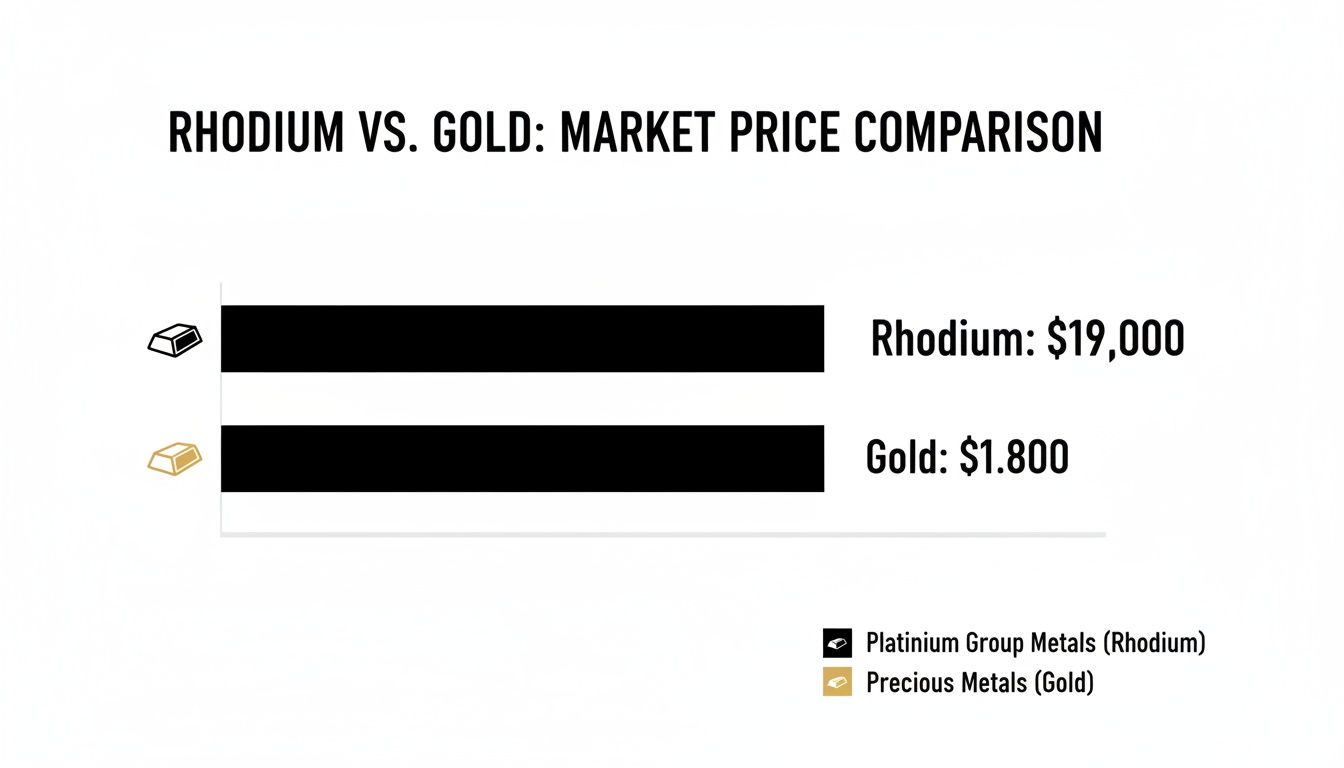
As you can see, the difference is staggering. This inherent value is a major reason why rhodium plating is considered a premium investment in your jewelry's beauty and durability.
Why It's Worth Paying for a Professional
It can be tempting to shop around for the absolute cheapest price, but this is one area where you get what you pay for. The cost reflects more than just the metal itself.
Even a basic replating job from a trusted local jeweler, which might run between $45 and $65, includes critical steps like a professional cleaning, polishing, and a check to ensure all your stone's prongs are secure. When you consider that a single bottle of the rhodium plating solution can cost a jeweler around $250, and the metal's price can soar above $20,000 per ounce (that's more than ten times the price of gold!), the need for an expert's touch becomes pretty clear.
One thing to keep in mind: Your location matters. A jeweler in a major city with high rent and overhead is naturally going to charge more than one in a small town.
Ultimately, investing in a professional service is about peace of mind. It ensures the job is done correctly, protecting not just the appearance of your jewelry but its structural integrity, too. Understanding these maintenance costs is especially important when thinking about the long-term care of a piece you wear every day, like a moissanite engagement ring. For a deeper dive, you might be interested in learning about the true cost of owning moissanite and how upkeep fits into the bigger picture.
How Often Will Your Jewelry Need Replating?
While it’s good to know the upfront rhodium plating cost, the question on every owner's mind is, "How often will I have to do this?" The honest answer? It completely depends. There's no magic number because the lifespan of your rhodium plating is tied directly to how you wear your jewelry.
Think of it like the tread on a car tire. A weekend cruiser that mostly sits in the garage will keep its tread for years. But a car that handles a gritty daily commute? Those tires will wear down much faster. Your jewelry is exactly the same.
A rhodium-plated pendant saved for special occasions might hold its bright, mirror-like finish for years on end. On the flip side, an engagement ring that's on your hand through dishwashing, workouts, and constant hand-sanitizing is a high-mileage piece. That super-thin protective layer is going to wear away much quicker simply from friction and exposure.
What Determines Your Replating Schedule?
How frequently you'll need to see your jeweler comes down to your lifestyle and what kind of piece you're wearing. Some jewelry is just in the line of fire more than others, which speeds up the erosion of that precious rhodium layer.
Here are the main things that affect how long your plating will last:
- How Often You Wear It: This is the big one. A ring you wear every day will need a new coat far sooner than earrings you only bring out once a month. Daily contact is the primary cause of wear.
- The Type of Jewelry: Rings and bracelets are constantly bumping and rubbing against things. Because of this, they almost always need replating much sooner than necklaces or earrings, which have less contact.
- Your Body Chemistry: It might sound strange, but your skin's unique pH can play a role. People with more acidic skin may find that the rhodium layer breaks down a little faster.
- Chemical Exposure: Lotions, perfumes, soaps, and especially harsh chemicals like chlorine in pools or household cleaners can strip the plating and dramatically shorten its life.
As a general rule, you can expect high-contact pieces like engagement and wedding rings to need replating every 12 to 24 months to keep looking their best. Items you wear less often can easily go for several years between treatments.
Telltale Signs It’s Time to Replate
Don't worry, your jewelry will give you some pretty clear hints when its rhodium shield is getting weak. You just have to know what to look for. The most common sign, particularly with white gold, is a subtle shift in color.
Since white gold is naturally a soft, creamy yellow, it depends on rhodium for that cool, bright-white look. As the plating wears off, that warmer metal underneath starts to show through. You'll usually spot it as yellowish or dull-looking patches, especially on the bottom of a ring's shank or on the prongs—the spots that see the most action.
This is completely normal! Seeing that hint of yellow is just your ring's way of telling you it's time for a spa day. Catching it early means you can plan for the quick maintenance trip and keep your jewelry looking brand new.
Professional Plating or a DIY Kit?
When you see those DIY rhodium plating kits online, the thought of saving a few bucks is definitely tempting. I get it. But when we're talking about precious jewelry—especially something as emotionally charged as an engagement ring—the decision isn't just about the initial rhodium plating cost. It’s really about getting a beautiful, durable finish that lasts.
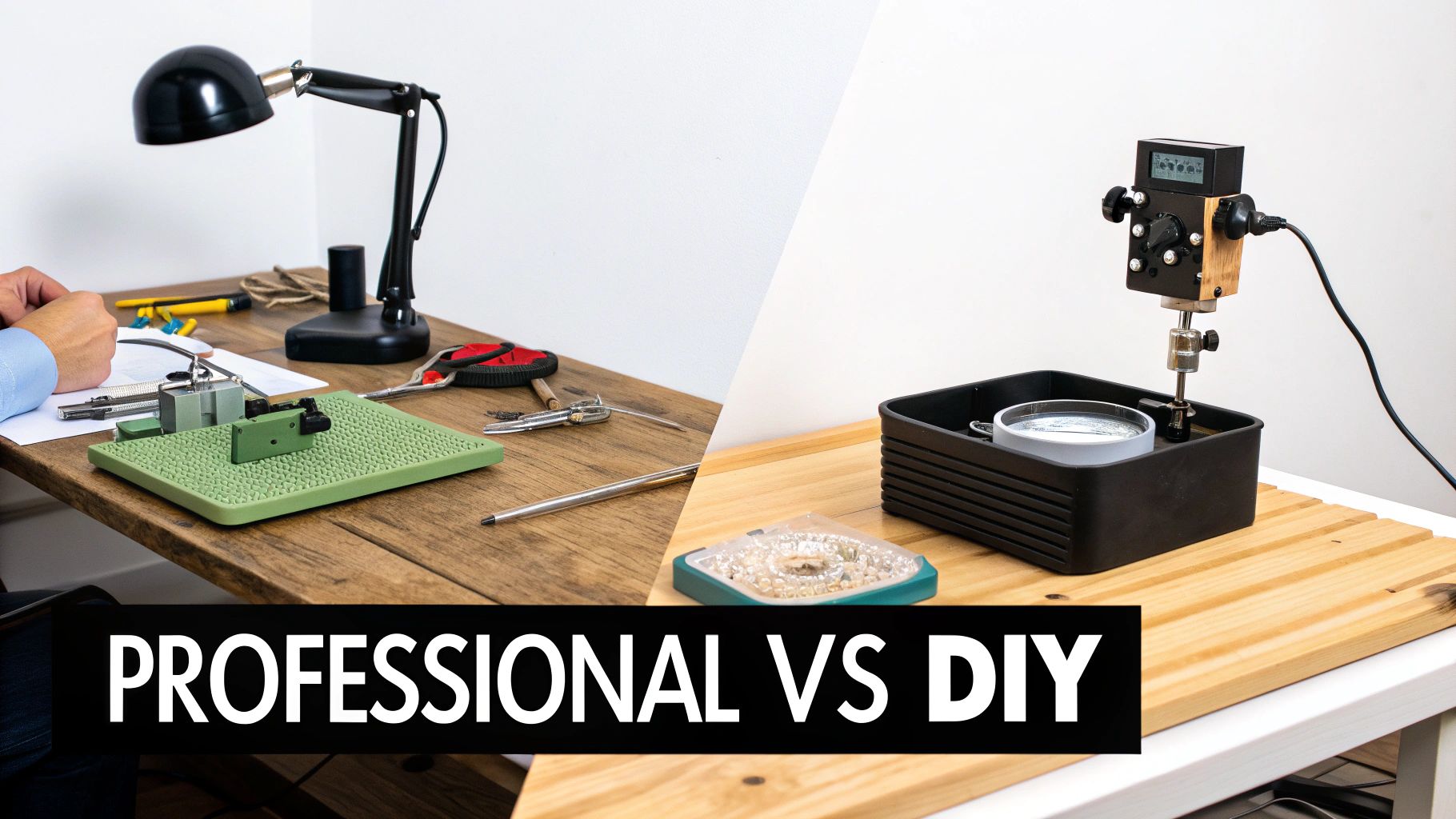
Going to a professional jeweler is a whole different ballgame. Their process is so much more than a quick dip in a solution. It all starts with painstaking surface preparation. We're talking deep cleaning with ultrasonic baths and a high-speed polish from an expert hand to buff out every single scratch and scuff.
This step is absolutely critical. Rhodium plating is incredibly thin, and it doesn't hide flaws—it actually magnifies them. If the surface isn't perfectly smooth and clean, you'll just be sealing those imperfections under the new rhodium layer.
DIY kits just can't compete here. They don't come with the high-tech equipment or, more importantly, the years of experience needed to get that flawlessly prepped surface. And without it, the rhodium simply won't bond properly.
The Hidden Risks of DIY Plating
The lower upfront cost of a DIY kit can be a siren song, but it often hides some serious risks that can end in disappointment and even damage. A home attempt can go wrong in a lot of ways, potentially costing you more to have a professional fix it later.
Here are the main drawbacks you're up against with a DIY kit:
- Uneven and Patchy Finish: Getting a smooth, consistent coating is a science. It requires precise voltage control and professional-grade solutions that you just don't get in a box. The most common result is a splotchy, amateurish look.
- Potential Gemstone Damage: The plating process uses acidic solutions and an electric current. If you don't know exactly what you're doing, it's frighteningly easy to damage delicate gemstones or weaken the prongs holding them in place.
- Poor Durability: Because the all-important prep work is missing, the rhodium layer from a DIY job is likely to wear off incredibly fast—sometimes in just a matter of weeks.
For a piece of jewelry you truly treasure, the peace of mind you get from a professional service is priceless. A jeweler guarantees a flawless, long-lasting finish that protects your investment and brings back that brand-new sparkle.
In the end, while a DIY kit might seem like a clever way to manage the rhodium plating cost, it’s a huge gamble. For your most cherished pieces, the expertise, specialized tools, and guaranteed results from a professional are always the right call. You're not just paying for a service; you're paying for craftsmanship and the certainty that your jewelry is in safe, skilled hands.
Making Your Rhodium Plating Last Longer
While replating is just part of owning white gold jewelry, you have a surprising amount of control over how often it's needed. Extending the life of your rhodium plating doesn't just keep your pieces looking fantastic; it also lowers your long-term rhodium plating cost. It all boils down to a few simple, conscious habits.
Think of that razor-thin rhodium layer like a protective clear coat on a car. Every time it rubs against something or gets hit with harsh chemicals, a tiny bit wears away. Those small interactions add up, eventually revealing the slightly yellowish white gold underneath. By simply reducing friction and chemical exposure, you can make that brilliant shine last much longer.
The trick is to treat your plated jewelry with the same gentle care you’d give a delicate silk garment—keep it away from anything abrasive or corrosive. A few small tweaks to your daily routine can make a world of difference.
Smart Habits to Preserve Your Plating
Want to keep that stunning, mirror-like finish? The best rule of thumb is the "last on, first off" policy.
- Remove Jewelry During Chores: Plain water is generally fine, but the soaps, detergents, and cleaning sprays you use are not. Make it a habit to take your rings off before washing dishes, scrubbing floors, or doing any household cleaning.
- Avoid Contact with Lotions and Perfumes: Always apply your cosmetics, lotions, hairspray, and perfume before putting on your jewelry. These products leave a residue that dulls the shine and can chemically erode the plating over time.
- Take It Off Before Swimming: Chlorine is rhodium's public enemy number one. It’s an aggressive chemical that can strip the plating surprisingly fast. Never wear your jewelry in a swimming pool or hot tub.
A common mistake is thinking that because rhodium is tough, it's invincible. While the metal is incredibly hard and resists scratches well, the plated layer itself is extremely thin. Its biggest weaknesses are constant friction and chemical exposure.
Protecting this precious metal layer is well worth the effort. Historically, rhodium prices can be quite volatile, often influenced by demand from the auto industry for catalytic converters. This market fluctuation affects what jewelers charge for replating, as you can see from rhodium's market dynamics at umicore.com.
However, because rhodium is so durable and tarnish-proof, it ultimately reduces the lifetime maintenance your jewelry needs, making it a smart investment. Proper care also includes gentle cleaning; our guide on how to clean moissanite rings shares safe methods that also protect the plating.
Not a Fan of Replating? Here Are Your Alternatives
Rhodium plating delivers that stunning, mirror-like white finish, but it's not a one-and-done deal. It comes with a recurring maintenance cost that can add up over the years. If you're planning a long-term investment, especially for something as significant as a moissanite engagement ring, it’s smart to look at all your options.
Exploring these alternatives might lead you to a metal that’s a much better fit for your lifestyle, budget, and personal style—and could save you from ever having to think about replating again. Each choice strikes a different balance between looks, durability, and cost, so let's break them down.
Embrace the Natural Warmth of White Gold
The simplest alternative? Just skip the plating altogether. Standard white gold is an alloy of pure gold mixed with white metals like nickel or palladium. On its own, it has a beautiful, soft, off-white hue—think light champagne. It’s a gorgeous look that feels a bit more vintage and understated.
- The Upside: You'll never need to replate it, which completely eliminates the long-term rhodium plating cost. The color is permanent and won't change.
- The Downside: It’s not that bright, silvery-white that many people associate with "white gold." Also, if the alloy contains nickel, it can be an issue for those with sensitive skin.
Invest in Platinum's Timeless Luster
If you want a naturally bright white metal without any plating, platinum is the top-tier choice. It’s a dense, incredibly durable metal that is also naturally hypoallergenic, making it perfect for anyone with metal sensitivities. Its cool, silvery-white color is its natural state—it will never fade or change.
One of platinum's most unique qualities is how it wears. Instead of rubbing away like gold, it develops a soft, satin finish known as a patina. Many people love this distinguished look, but if you prefer the high shine, a quick professional polish will restore it.
The main thing to consider with platinum is the higher upfront cost. It’s rarer and denser than gold, so it commands a premium price. However, that initial investment gets rid of the replating expense for good. To find the perfect stone to pair with it, you can explore our guide on what is moissanite.
Consider Palladium White Gold: The Best of Both Worlds
Looking for a fantastic middle-ground option? Palladium white gold is your answer. This alloy uses palladium (a metal from the platinum family) instead of nickel, making it an excellent hypoallergenic choice.
Its natural color is a grayish-white that’s noticeably brighter than unplated, nickel-based white gold, often making rhodium plating unnecessary. It truly offers a compelling balance: you get the durability and hypoallergenic properties of platinum with a price point much closer to traditional gold.
Common Questions About Rhodium Plating
To wrap things up, let's tackle some of the most common questions people ask about rhodium plating. Think of this as a quick-fire round to clear up any final uncertainties, helping you feel totally confident in your jewelry choices.
Is Rhodium Plating Safe to Wear?
Absolutely. One of the best things about rhodium is that it's hypoallergenic.
Since it's nickel-free, it acts as a safe buffer between your skin and the base metal of your jewelry (like the nickel alloys sometimes found in white gold). This makes it a fantastic option for anyone with sensitive skin.
Will Rhodium Plating Turn My Finger Green?
Nope, pure rhodium will never tarnish or leave a green mark on your skin.
If you ever see discoloration, it's a dead giveaway that the plating has worn off completely. What you're seeing is your skin's reaction to the base metal underneath, such as the copper alloys in sterling silver.
Can You Plate Yellow Gold with Rhodium?
Yes, you definitely can! Jewelers often plate yellow or rose gold to give it that crisp, cool look of white gold.
Just keep in mind, it's a cosmetic fix, not a permanent change. As the rhodium layer wears away, the warmer yellow or rose tones of the original gold will start peeking through. To keep the bright white look, you'll need to commit to regular replating.
Rhodium plating is a surface treatment, not a forever solution. For a high-contact piece like a ring, you can generally expect the plating to last 12 to 24 months before it starts showing signs of wear.
What Does the Plating Process Involve?
Getting a piece of jewelry rhodium-plated is a meticulous process that goes way beyond a simple dip. A skilled jeweler will:
- Thoroughly Clean: First, your jewelry gets a deep, professional cleaning to strip away any lingering dirt, oils, or lotions.
- Expertly Polish: Next, it’s polished to a flawless, mirror-like finish to buff out any scratches. This smooth surface is crucial for the next step.
- Electroplate: Finally, the piece is submerged in a rhodium solution. An electric current is passed through it, which fuses a microscopic layer of rhodium onto the base metal.
This careful preparation is exactly why professional replating is worth it. It ensures the rhodium bonds perfectly, giving you that brilliant, like-new shine that lasts.
At Moissanite Diamond, we believe knowledge is key to loving and caring for your jewelry for years to come. We invite you to explore our collections of brilliant, ethically sourced moissanite pieces designed to last a lifetime.