
So, you're trying to decide between a lab-grown diamond and a moissanite? The whole debate really boils down to one simple thing: what they're made of. A lab-grown diamond is a real diamond through and through—pure carbon, just like one from the earth. Moissanite, on the other hand, is a completely different gemstone made from silicon carbide that's famous for its wild, rainbow-like sparkle.
The right choice for you depends on what you value most: the timeless, classic appeal of a diamond or a unique, fiery gem that offers more size for your money.
Choosing Your Ideal Center Stone
Gone are the days when a mined diamond was your only option for a show-stopping center stone. Today, lab-grown diamonds and moissanite are two of the most popular choices out there—and for good reason. They’re both beautiful, ethical, and created in a lab rather than pulled from the ground.
But here’s the thing: they aren’t the same. While they might look similar at a quick glance, understanding what makes each one unique is the key to choosing the right stone for such a big moment. This guide will cut through the noise and give you a straight-up, honest comparison so you can feel great about your decision.
What Really Matters in Your Decision
Picking between these two isn’t just about which one looks prettier. It’s about finding the gem that fits your style, your budget, and what's important to you.
Here are the four things you really need to think about:
- How it Sparkles: Are you drawn to the crisp, white light of a diamond (brilliance), or do you love the vibrant, colorful flashes of a moissanite (fire)?
- Everyday Durability: How tough is it? You want a stone that can handle being worn every single day for the rest of your life.
- Price and Value: What’s the price tag look like, and how does that affect the size and quality of the stone you can get?
- The Ethical Side: Both are lab-made, but how do their creation processes stack up when it comes to being green and clean?
If you remember one thing, make it this: a lab-grown diamond is a diamond. It has the exact same chemical and physical properties as a mined one. Moissanite is a stunning gem in its own right, known for its incredible durability and sparkle, but it's a completely different stone.
Here’s a quick side-by-side to see how they compare at a glance.
| Feature | Lab-Grown Diamond | Moissanite |
|---|---|---|
| Composition | Pure Carbon (C) | Silicon Carbide (SiC) |
| Brilliance | High (classic white sparkle) | Very High (intense rainbow fire) |
| Hardness (Mohs) | 10 (Hardest known mineral) | 9.25 (Extremely durable) |
| Price | More expensive per carat | Significantly more affordable |
| Ethical Sourcing | Lab-created, avoids mining | Lab-created, avoids mining |
| Best For | Buyers wanting a true diamond | Buyers prioritizing size and sparkle for budget |
By digging into each of these areas, you'll go from asking "which one is better?" to knowing exactly "which one is better for me." Let's break it all down so you can find the perfect stone you'll be happy with for years to come.
What Are These Gemstones, Really? A Look at the Science
To really get to the heart of the lab-grown diamond vs. moissanite decision, you need to understand what these stones actually are. On the surface, they're both brilliant, lab-created gems. But dig a little deeper, and you'll find they have completely different scientific identities, which affects everything from how they sparkle to how they're categorized.
A lab-grown diamond is just that: a real diamond. It has the exact same chemical DNA as one pulled from the earth—pure carbon atoms locked into that classic crystal structure. It’s physically, chemically, and optically identical to a natural diamond.
This means you get the same legendary hardness and the same timeless, brilliant sparkle that have made diamonds the go-to symbol for commitment.
How Lab Diamonds Are Made
Scientists have figured out how to recreate the intense heat and pressure from deep within the Earth's mantle, but in a controlled lab setting. It all starts with a tiny diamond "seed," and from there, two main methods take over.
- High Pressure/High Temperature (HPHT): Think of this as a high-tech pressure cooker. It mimics nature by subjecting a carbon source to extreme pressure and heat, forcing it to crystallize onto the diamond seed.
- Chemical Vapor Deposition (CVD): This method is more like 3D printing on a molecular level. The seed is placed in a chamber filled with carbon-rich gas. When heated, the gas releases carbon atoms that build up on the seed, growing the diamond layer by layer.
Both techniques produce a gemstone that is indistinguishable from a mined diamond without the help of highly specialized gemological tools.
The key thing to remember is this: A lab-grown diamond isn't a "fake" or a "simulant." It's a genuine diamond through and through, just with a different origin story.
Moissanite, on the other hand, is a completely different gemstone. It was first discovered back in the late 1800s by a French chemist named Henri Moissan, who found tiny crystals in a meteor crater. Natural moissanite is ridiculously rare, so virtually all the moissanite you see in jewelry today is created in a lab.
The Unique Makeup of Moissanite
Unlike a diamond, which is pure carbon, moissanite is made of silicon carbide (SiC). This unique chemical formula is responsible for its famous fiery sparkle—that rainbow-like flash that makes it stand out from every other gem on the market.
Creating moissanite involves a thermal growing process that can take a few months to yield a large, high-quality crystal. That crystal is then carefully cut to show off its signature fire and brilliance.
So, when you're weighing lab-grown diamond vs. moissanite, you aren't comparing a "real" stone to a "fake" one. You're comparing two entirely separate, legitimate gemstones. One is a diamond (carbon), and the other is a moissanite (silicon carbide). Getting this fundamental difference is the first step in figuring out which one is the right fit for you.
A Visual Showdown of Brilliance and Fire
When you place a lab-grown diamond and a moissanite side-by-side, the most striking difference is how they play with light. This isn't just about general "sparkle"; it’s about the unique personality each stone shows off through its brilliance and fire.
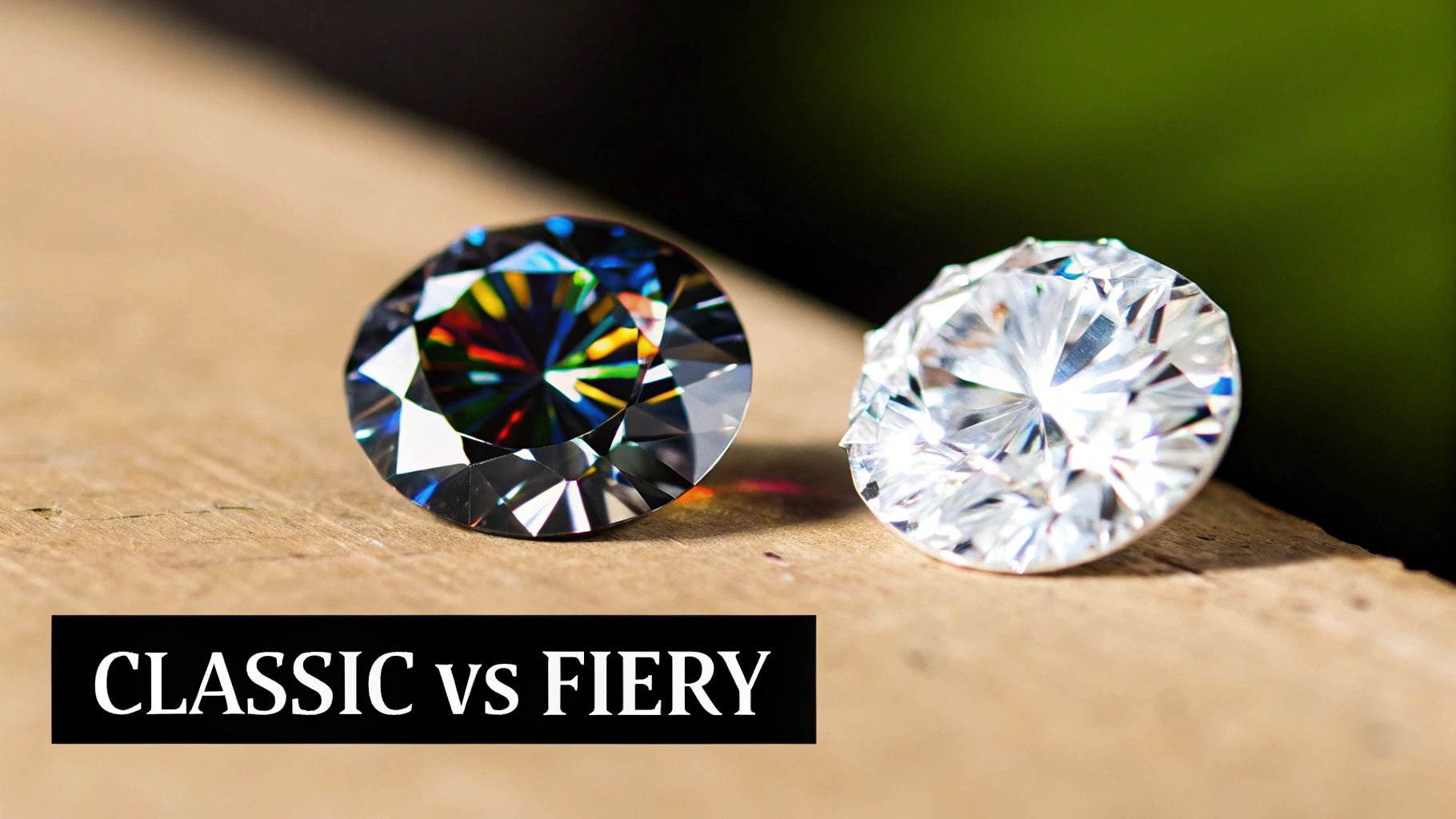
Brilliance is the clean, white light that reflects back to your eye, giving a stone its bright, crisp quality. Fire, on the other hand, is the beautiful dispersion of that light into a rainbow of colors. Think of it as the vibrant, colorful flashes you see when the stone moves.
The Classic Sparkle of a Lab-Grown Diamond
With a refractive index of 2.42, a lab-grown diamond is expertly cut to maximize its white light return. The result is a beautifully balanced performance where crisp white flashes are punctuated by subtle, elegant bursts of color. It's a timeless and sophisticated sparkle that has been the gold standard for generations.
This is the look most people imagine when they think of a classic engagement ring. It's a powerful yet understated brilliance that looks stunning in any light without ever feeling over the top.
The Fiery Personality of Moissanite
Moissanite offers a completely different light show. Its refractive index is much higher, ranging from 2.65 to 2.69, which means it bends and disperses light far more dramatically than a diamond. This creates an incredible explosion of rainbow colors.
People often describe this as a vibrant, "disco-ball" effect. In direct sunlight or under spotlights, a moissanite will throw off intense, fiery flashes that are simply impossible to miss. If you love a bold, colorful sparkle, moissanite's intense fire is its biggest draw. You can learn more about why moissanite sparkles so differently in our deep-dive article.
A key optical property setting moissanite apart is its double refraction. When light passes through, it splits into two rays. While you’d likely never notice it with the naked eye, a trained gemologist can see this as a slight doubling of the facet junctions under magnification, adding another layer to its unique visual fingerprint.
Ultimately, neither is "better"—it all comes down to the look you love.
To help you see the differences at a glance, here’s a quick summary of their visual characteristics.
Visual Characteristics Lab-Grown Diamond vs. Moissanite
| Characteristic | Lab-Grown Diamond | Moissanite |
|---|---|---|
| Primary Sparkle | Crisp white brilliance | Intense rainbow fire |
| Refractive Index | 2.42 | 2.65 - 2.69 |
| Visual Effect | Balanced, sharp, and classic | Fiery, vibrant, and bold |
| Best For | Someone who loves timeless elegance | Someone who wants maximum sparkle and color |
This table shows that while both stones are beautiful, they offer very different experiences.
Choosing Your Sparkle Profile
So, which one is right for you? Think about where and how you’ll be wearing your ring.
-
For Understated Elegance: If you want a sophisticated sparkle that looks incredible with everything but doesn't steal the show, the classic brilliance of a lab-grown diamond is perfect. It performs beautifully in all lighting, from a candlelit dinner to a day at the office.
-
For Maximum Impact: If you love turning heads and want a gem that puts on a dazzling show, moissanite's fire is unbeatable. It truly comes alive in places with dynamic lighting, like restaurants, concerts, or just a sunny afternoon.
The visual contest between a lab-grown diamond and moissanite is won by the stone that best reflects your personal style. One delivers a classic, sharp brilliance; the other provides a fiery, rainbow-filled spectacle. By understanding this core difference, you can confidently choose the gemstone you’ll love watching sparkle for a lifetime.
Comparing Durability for Everyday Wear
When you're choosing a stone for an engagement ring—something you’ll wear every single day—durability is everything. You need a gem that can handle the reality of daily life, from accidental bumps against a countertop to a lifetime of wear, without losing its luster. The good news is, this is where both lab-grown diamonds and moissanite really shine.
The go-to measure for gemstone toughness is the Mohs scale, which ranks materials on a scale of 1 to 10 based on their scratch resistance. It’s a simple concept: can a harder mineral scratch a softer one? For a ring you never take off, a high score is non-negotiable.

Lab-Grown Diamonds: The Top of the Scale
A lab-grown diamond is, chemically, a diamond. That means it lands a perfect 10 out of 10 on the Mohs scale. It’s not just a high score; it's the highest possible. As the hardest mineral on earth, its carbon atoms are bonded so tightly that almost nothing can scratch it.
What does this mean for you? Essentially, the only thing that can scratch your diamond is another diamond. This is precisely why diamonds have been the default for engagement rings for generations—they are built to be worn and to last, keeping their sharp facets and pristine surface for decades.
Moissanite: Exceptionally Resilient
Moissanite isn't far behind, coming in at a very impressive 9.25 on the Mohs scale. This makes it one of the toughest substances on the planet and the second-hardest gemstone you'll typically find in fine jewelry. Made of silicon carbide, its molecular structure is incredibly durable.
While a diamond is technically harder, the real-world difference is almost negligible. Moissanite is more than tough enough for the rigors of daily life. It easily stands up to scrapes against metals, door frames, and other common surfaces, so you don't have to worry about it losing its sparkle.
Here's the bottom line: While a diamond is the undisputed king of hardness, moissanite's 9.25 score is well above the threshold for a durable, lifelong gemstone. For all practical purposes, both are fantastic choices.
How They Hold Up in Real Life
So, how does this play out day-to-day? Let’s look at a few common scenarios when comparing a lab-grown diamond vs. moissanite:
- Accidental Bumps & Knocks: Both stones are incredibly tough. Thanks to their robust crystal structures, they can handle an accidental impact against a hard surface without chipping or breaking.
- Daily Tasks & Chores: You won’t have to worry about scratching either stone on household items or common metals.
- Long-Term Sparkle: Over the years, both will keep their smooth, polished facets and sharp edges. Their brilliance won't fade due to surface wear and tear.
When it comes to durability, the choice isn’t about which one is "better," but recognizing that both are top-tier options. Whether you go with the unmatched hardness of a lab-grown diamond or the outstanding resilience of moissanite, you're getting a stone that’s ready for a lifetime of adventure.
Unpacking the True Cost and Long-Term Value
Let’s be honest: for most of us, the final decision between a lab-grown diamond and moissanite really comes down to budget. The price tag doesn't just represent a cost; it directly influences the size, quality, and overall "wow" factor of the stone you can ultimately choose. Getting a firm grip on the cost differences—and what "value" truly means for each stone—is the key to making a purchase you'll love for years.
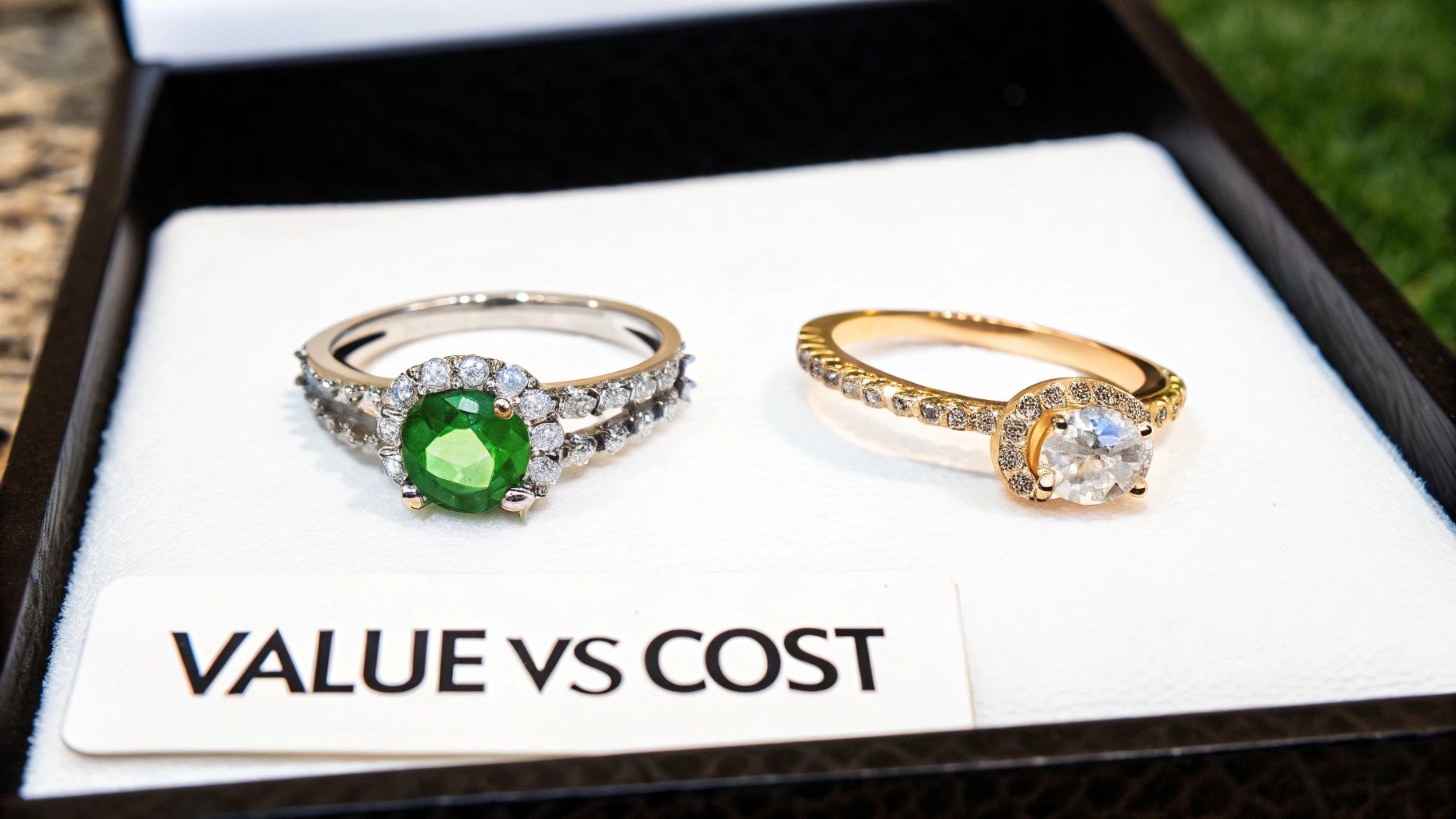
The most dramatic difference between these two gems is, without a doubt, the price. Moissanite is significantly more affordable, often costing a staggering 80-90% less than a lab-grown diamond of a similar size and appearance. This isn't just a minor discount; it’s a total game-changer that can completely redefine the possibilities for your ring design.
A Real-World Price Comparison
To see what this looks like in practice, let’s talk numbers. Say you have your heart set on a classic 1-carat round brilliant stone for an engagement ring.
- A high-quality 1-carat lab-grown diamond will typically run you somewhere between $1,000 and $2,000, based on its specific cut, color, and clarity grades.
- In contrast, a visually comparable 1-carat moissanite with stunning sparkle and clarity will likely cost between $250 and $500.
This price gap is huge. It means that for what you'd spend on a 1-carat lab diamond, you could easily get a 2 or even 3-carat moissanite, a more elaborate setting, or throw in a matching wedding band—all without blowing your budget. The market is clearly taking notice of this appeal. While natural diamonds average around $4,200 per carat, the moissanite industry is forecasted to jump from $68.6 billion in 2026 to an incredible $112.3 billion by 2033.
Defining Long-Term Value
When we talk about value in the lab grown diamond vs moissanite debate, we’re really talking about two separate things: immediate affordability versus long-term resale potential. This is where your personal priorities really matter.
A lab-grown diamond, because it is a diamond, comes with a higher price tag but also holds onto some of its financial value. While it won't appreciate like a rare mined diamond, it does have a modest resale market. You can think of it as a higher initial investment for a gem that has an established place in the industry.
Moissanite’s value is a completely different story. Its worth is all about that amazing upfront affordability. You’re not buying it as a financial asset; you're buying it as a beautiful, durable gemstone that lets you get the look you want without compromise.
The choice really boils down to this: Do you want to invest more in a stone that is chemically a diamond with some resale potential, or do you want to maximize the size and brilliance of your jewelry for the same budget? There is no wrong answer.
What Does This Mean for You?
Understanding this financial distinction is critical for making a confident choice. To get a clearer picture of market pricing and the business side of things, it can be helpful to check out resources on moissanite jewelry wholesale, which can shed light on why it offers such a compelling price.
Here’s a simple way to frame your decision:
- Choose a lab-grown diamond if: Your top priority is owning a stone that’s chemically identical to a natural diamond, and you're comfortable with the higher cost for a gem that retains some resale value.
- Choose moissanite if: Your main goal is to get the biggest, most brilliant stone your money can buy. Its value is in the immediate joy and stunning visual impact it delivers.
For a more detailed breakdown of this topic, you might find our guide on what's best for your budget helpful. At the end of the day, both stones offer fantastic value—it just depends on how you define it.
Navigating Ethical and Sustainable Choices
For a growing number of people, the story behind their gemstone is just as important as its sparkle. If you're comparing a lab-grown diamond vs. moissanite on ethics, the great news is you're already looking at two fantastic alternatives to mined diamonds. Both completely sidestep the environmental devastation and human rights issues tied to traditional mining.
Because both are created in a controlled lab, you can be confident your jewelry is conflict-free and carries a much lighter environmental footprint. That said, if you really want to get into the weeds of sustainability, there are a few subtle but important differences to understand.
Comparing Carbon Footprints
While both stones are born above ground, their creation processes have different energy needs. Lab-grown diamonds, whether made through HPHT or CVD methods, require a massive amount of energy to mimic the intense heat and pressure found deep within the Earth. This can lead to a pretty hefty carbon footprint, which varies widely depending on the lab's energy source.
Moissanite, on the other hand, is typically made using a more direct and energy-efficient thermal growing process. From start to finish, this often means its environmental impact is smaller. For anyone whose top priority is the absolute lowest ecological footprint, moissanite has a clear edge here.
The bottom line: Both lab-created stones are responsible choices, but for those who value minimal environmental impact above all else, moissanite often holds a slight advantage, offering true peace of mind.
The Rise of Conscious Consumerism
The move toward sustainable luxury is real, and it’s changing how we buy fine jewelry. Today, between 65-70% of Millennial and Gen Z shoppers are actively looking for eco-friendly luxury goods. They're turning away from mined diamonds because of concerns over carbon emissions and habitat destruction.
This shift is a huge reason why the moissanite market is expected to jump from $37 million to $64 million by 2032. For a lot of ethically-driven buyers, moissanite delivers a clean conscience, sidestepping even the energy-heavy process of creating a lab diamond while offering full traceability. You can find more data on this trend at persistencemarketresearch.com.
Here’s a quick breakdown to help you see the ethical landscape at a glance.
| Ethical Consideration | Lab-Grown Diamond | Moissanite |
|---|---|---|
| Conflict-Free | Yes, completely lab-created. | Yes, completely lab-created. |
| Mining Impact | None, avoids environmental damage. | None, avoids environmental damage. |
| Carbon Footprint | Varies by lab, but can be energy-intensive. | Generally lower due to an efficient creation process. |
| Sustainability | A strong sustainable choice. | Often considered the most sustainable choice. |
This table makes it clear that you aren’t choosing between a "good" and a "bad" option. Instead, you're deciding between two excellent, ethical stones with slightly different environmental profiles. You can learn more about why moissanite is the ethical choice for modern jewelry lovers in our dedicated article.
Ultimately, picking either a lab-grown diamond or a moissanite is a vote for a more responsible jewelry industry. Your choice will likely come down to which stone’s specific advantages line up best with your personal values.
So, Which One Is Right for You?
Choosing between a lab-grown diamond and moissanite isn't about which stone is "better"—it's about which one is better for you. It really comes down to what you value most in a gemstone. Now that we’ve broken down the sparkle, durability, and cost, you can zero in on the perfect fit for your style and budget.
Think about it this way: are you drawn to the classic, icy legacy of a true diamond, or do you want the most jaw-dropping sparkle you can get for your money? Once you have the answer to that, the choice becomes much clearer.
A Simple Way to Decide
Let's cut through the noise. The best way to figure this out is to see which of these scenarios feels most like you. This isn't a quiz, just a practical way to match your personal vision to the right stone.
One of these profiles will likely resonate more than the other, guiding you to a decision that feels right.
Your final choice should feel like a reflection of your own story and style. One person’s perfect stone might be another’s second choice, and that’s exactly how it should be. Trust your instincts and what you find beautiful.
By aligning your desires with the unique strengths of each stone, you can move forward with total confidence.
A Lab-Grown Diamond Is Your Stone If…
You want a stone that is chemically and physically identical to a mined diamond, no questions asked. The idea of a diamond—its history, its timeless appeal—is important to you. You prefer its signature crisp, white brilliance over a fiery rainbow sparkle.
- Tradition matters: You want a real diamond, plain and simple, even if it’s created in a lab.
- You love classic sparkle: That sharp, balanced return of white light is the look you’re after.
- Your budget has some room: You're comfortable with a higher price tag for a stone that holds a bit more long-term value.
Moissanite Is Your Stone If…
You're looking for the biggest and most brilliant gemstone your money can buy. The intense, rainbow-colored fire of moissanite absolutely captivates you, and you love the idea of a stone that puts on a dazzling light show. Maximizing visual impact and making an ethical choice are at the top of your list.
- Size and sparkle are your priorities: You want the most "wow" factor possible for your budget.
- You're all about that rainbow fire: The vibrant, "disco-ball" effect is more exciting to you than a subtle white glimmer.
- Affordability is a major factor: You want a gorgeous, durable stone without breaking the bank, which might free up funds for an intricate setting or a matching wedding band.
At the end of the day, both lab-grown diamonds and moissanite are stunning, durable, and responsible choices. It's a personal decision. By figuring out what truly speaks to you—the classic identity of a diamond or the fiery brilliance of moissanite, a potential investment or incredible upfront value—you can confidently pick the gemstone you’ll love for a lifetime.
Ready to find the brilliant, fiery stone that speaks to you? Explore the stunning, ethically sourced collections at Moissanite Diamond and discover the perfect piece that aligns with your style and values. Shop our curated engagement rings and fine jewelry today!