
Lab-created moissanite is a stunning gemstone born from silicon carbide. It's engineered in a controlled environment to offer the same kind of jaw-dropping beauty you'd expect from any mined gem, but without the hefty price tag or ethical baggage.
Think of it this way: it’s not a "fake diamond." It’s a completely unique masterpiece, meticulously grown from a scientific seed.
A Brilliant Choice for Modern Jewelry
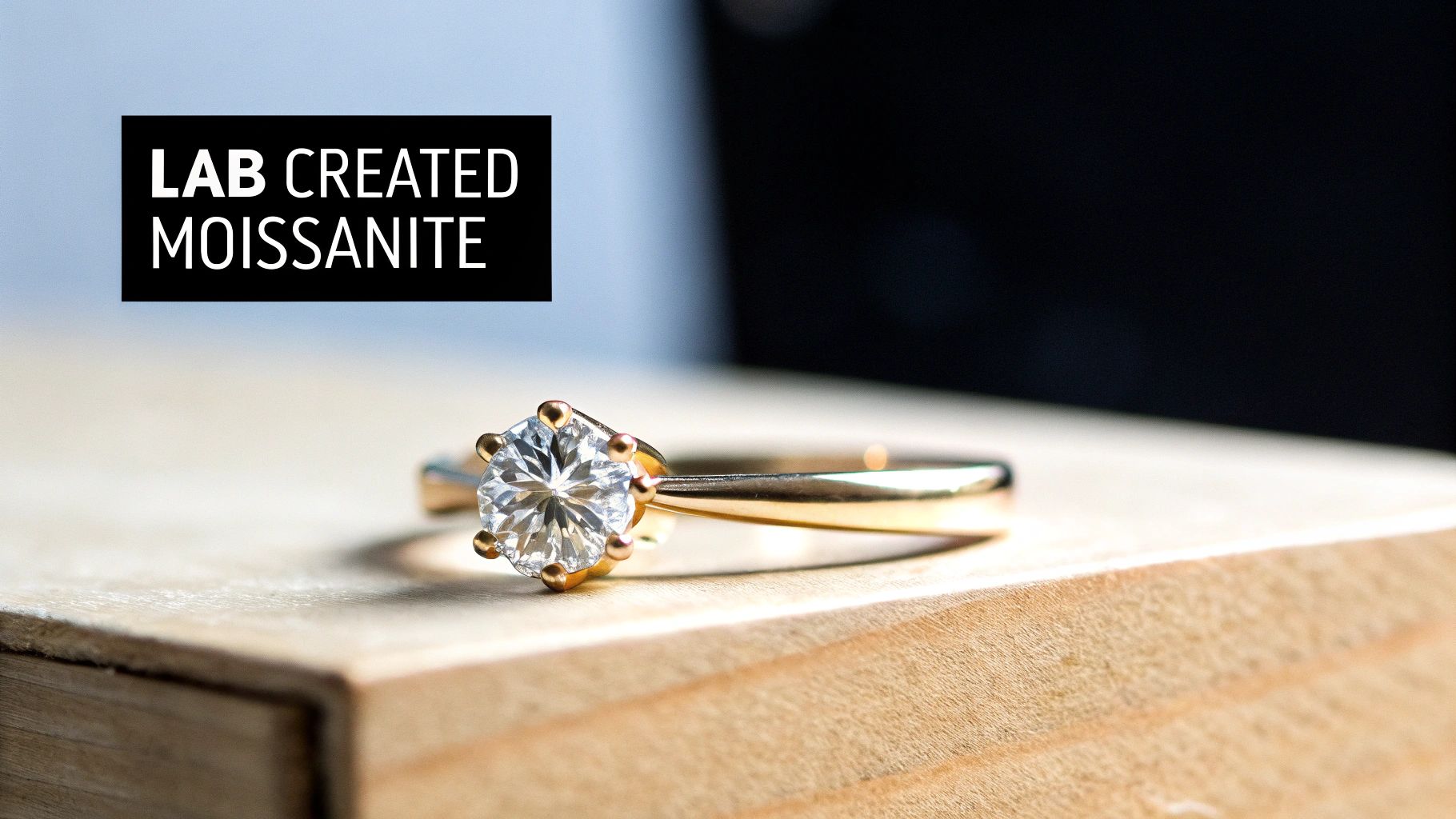
Many people hear "lab-created" and immediately think "imitation," but moissanite is a gemstone in its own right, with a fascinating origin story. The natural stuff is unbelievably rare, first discovered by French chemist Henri Moissan back in 1893 inside a meteorite crater.
Because of its cosmic rarity, virtually all moissanite you see in jewelry today is carefully grown in a lab. This process perfectly mimics the intense heat and pressure that formed the original, ensuring every single stone is flawless and conflict-free. This has made it a go-to choice for everything from gorgeous engagement rings to everyday sparkle.
How Lab Moissanite Became a Star
The journey from a space rock mineral to a beloved gemstone really took off in the late 1980s. Researchers at a company called Charles & Colvard cracked the code for commercially producing gem-quality silicon carbide. By 1998, they introduced the first moissanite gems to the public, and the jewelry world was never the same.
This breakthrough opened the door for more people to own brilliant, tough-as-nails gemstones. You can learn more about how this innovation impacted moissanite pricing and availability. Unlike mined gems, which often carry a heavy environmental and ethical toll, lab-grown stones come with a clean story—a perfect fit for today's conscious consumer.
Choosing a lab-created moissanite means you get a visually stunning gemstone with a clear conscience. You are selecting a piece that is guaranteed to be conflict-free and environmentally friendly, without sacrificing brilliance or durability.
Moissanite at a Glance
So, what truly sets moissanite apart? Let's break down the key characteristics that make it such a compelling alternative to traditional diamonds. This quick comparison table highlights the major differences at a glance.
| Attribute | Lab-Created Moissanite | Mined Diamond |
|---|---|---|
| Composition | Silicon Carbide (SiC) | Carbon (C) |
| Hardness (Mohs) | 9.25 | 10 |
| Brilliance (Fire) | Exceptional rainbow sparkle | Bright white sparkle |
| Origin | Lab-grown, ethical | Mined from the earth |
| Cost | Significantly more affordable | High, premium price |
Understanding these distinctions helps clarify why moissanite isn't just a substitute for a diamond but a fantastic choice on its own terms.
Key Features That Shine
When you dig into the details, you find a few core traits that really define moissanite’s appeal.
- Exceptional Brilliance: Moissanite has what’s called a higher refractive index than a diamond. In simple terms, it bends light more intensely, creating those fiery, rainbow-colored flashes that are impossible to miss.
- Impressive Durability: It scores a 9.25 on the Mohs scale of hardness, making it one of the toughest substances on earth. A diamond is a perfect 10, but moissanite is right behind it, making it more than durable enough for daily wear.
- Affordable Luxury: Because the entire process happens in a controlled lab setting, the cost to produce a moissanite is a fraction of what it takes to mine a diamond of similar size and quality.
- Ethical and Sustainable: Growing a gemstone avoids the massive environmental disruption and ethical concerns that have long plagued the diamond mining industry.
How Moissanite Is Grown in a Lab
The story of a lab created moissanite doesn't start in a mine, but in a state-of-the-art laboratory. Scientists take a simple raw material, silicon carbide, and transform it into a stunning gemstone. The whole process is designed to mimic the intense conditions found deep within the earth—or even in interstellar space—where the first traces of natural moissanite were discovered.
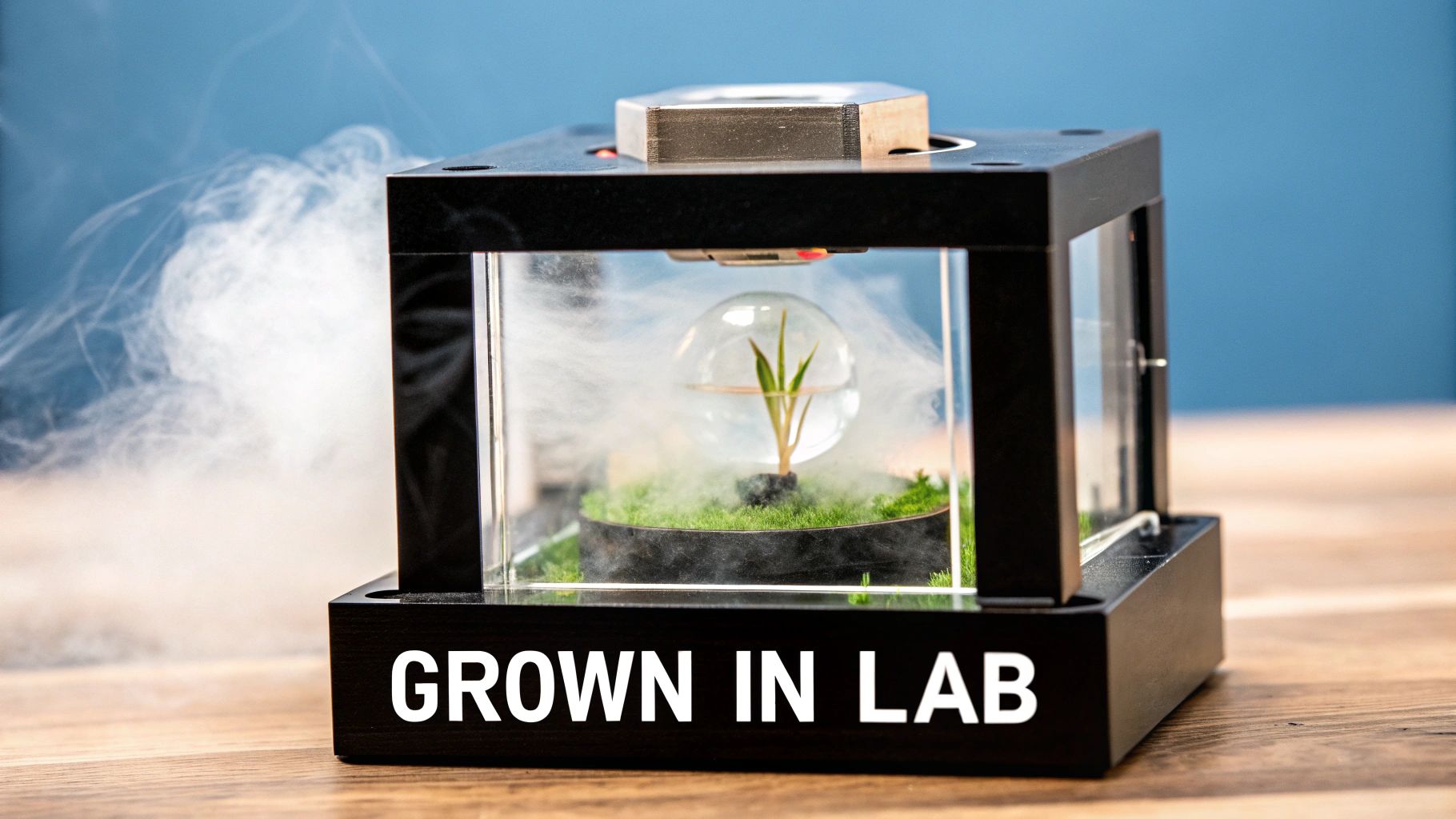
Think of it like nurturing a perfect crystal in a high-tech greenhouse. It all begins with a tiny sliver of silicon carbide, called a seed crystal. This seed is placed into a highly controlled chamber where it’s subjected to immense heat and pressure. The goal isn't just to copy nature; it's to perfect it, creating flawless gems every single time.
At the heart of the process, silicon carbide powder is heated until it vaporizes. This gas then slowly settles onto the seed crystal, layer by layer, building the gemstone molecule by molecule over several weeks or even months.
The Thermal Growing Process
The most common technique for growing these beautiful gems is a version of the Lely process. This method relies on sublimation—a neat scientific trick where a solid turns directly into a gas, skipping the liquid stage entirely.
Here’s a look at how it works, step by step:
- Preparation: A small, perfect moissanite seed crystal is secured inside a growth chamber.
- Vaporization: Pure silicon carbide powder is heated to blistering temperatures, often over 2,000° Celsius (that's about 3,632° Fahrenheit), causing it to become a vapor.
- Crystallization: The slightly cooler seed crystal acts like a magnet for the gaseous silicon carbide. As the molecules land on the seed, they align themselves into a perfect crystal lattice, gradually growing a larger, single-crystal moissanite.
- Cooling and Cutting: Once the crystal is large enough, it’s carefully cooled down. This raw crystal, known as a boule, is then handed over to master gem cutters who facet it to unlock its incredible fire and brilliance.
This incredibly precise, controlled method is what gives moissanite its signature consistency. Unlike mined gems that often have flaws or color inconsistencies, every lab created moissanite is grown for perfection, guaranteeing outstanding clarity and color.
Because each stone is created under such strict standards, the final product is a gorgeous, conflict-free gemstone with a level of quality you'd be hard-pressed to find in nature. This ethical and meticulous process ensures you get a brilliant stone you can feel great about wearing, which is a core value behind our collections at Moissanite Diamond. It’s how we make sure every piece, from our Lavana rings to our Hajani earrings, sparkles with consistent, jaw-dropping beauty.
Understanding Moissanite Brilliance and Fire
The first thing that grabs your attention with a lab-created moissanite is its absolutely incredible sparkle. This isn't just one thing; it's a stunning light show made up of two key qualities: brilliance and fire. Once you know the difference, you'll really start to see what makes this gemstone so special.
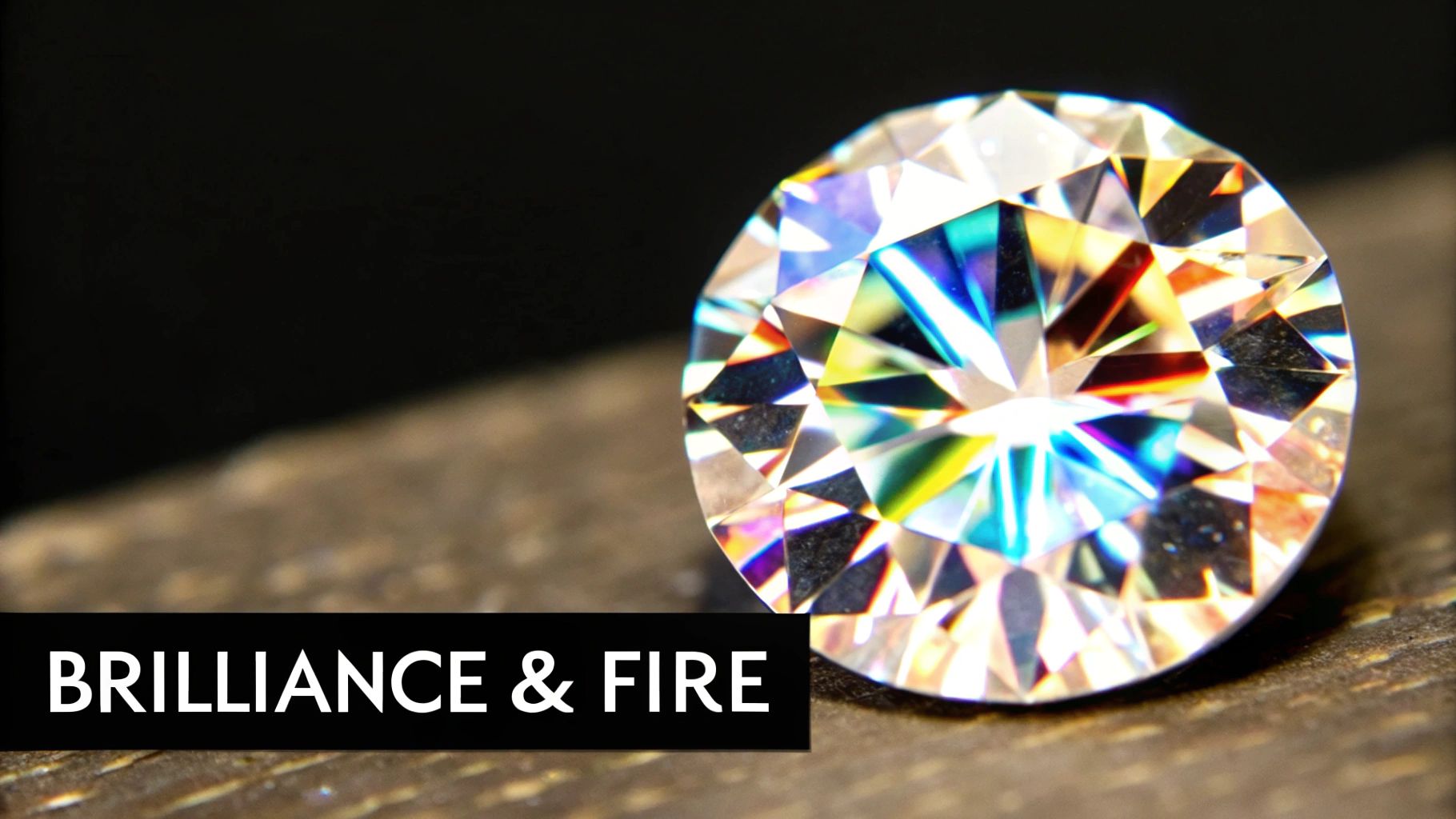
Brilliance is all about the pure, white light that a gem reflects back at you. Think of the crisp, almost mirror-like flash you see in a high-quality diamond—that's brilliance.
Fire, on the other hand, is the explosion of rainbow colors that appear when light passes through the stone. It's those vibrant, colorful flashes that dance around as the gem moves. This is where moissanite doesn't just shine; it puts on a show.
The Science Behind the Sparkle
So, what's the secret behind moissanite's intense light performance? It all comes down to its high Refractive Index (RI). In simple terms, a gem's RI measures how much it bends light. The higher the RI, the more light it can capture and shoot back out as sparkle.
Let's look at the numbers:
- Moissanite's RI: A stunning 2.65 to 2.69.
- Diamond's RI: A respectable 2.42.
That higher number for moissanite means it's an absolute master at bending and reflecting light. You could think of a diamond as a bright, clean mirror and moissanite as a dazzling disco ball. Both are brilliant, but moissanite throws a breathtaking rainbow of color across the room.
This unique optical property is why moissanite often looks so lively and impressive, especially under sunlight or spotlights. Its structure is simply built to maximize both white and colored light return, giving it that signature, eye-catching flash.
This isn't just a small difference; it’s something you can see. Moissanite’s brilliance outshines a diamond's, delivering 10-20% more fire. To the untrained eye, this can even make the stone look bigger and flashier. In fact, some studies from the International Gem Society suggest moissanite can appear 8-20% larger than a diamond of the same size, especially when comparing stones within a similar budget.
What This Means for Your Jewelry
What all this science boils down to is a gemstone that demands to be seen. The vibrant rainbow flashes create an effect that's both brilliant and full of life, making it a fantastic choice for pieces that are meant to be noticed, like an engagement ring or a show-stopping pendant.
Another part of its charm is how it adapts to its surroundings. You'll see those intense, fiery flashes under direct sunlight, but in softer indoor light, you might notice a more subtle, white brilliance. It's a dynamic stone that always has a new look to show you. To see more on this, check out our article on why moissanite sparkles differently in various lighting conditions.
Comparing Moissanite and Diamond Value
When you start looking at engagement rings, it's easy to get "value" and "price" mixed up. Yes, a lab created moissanite costs a whole lot less than a diamond, but its real value is so much more than just the number on the price tag. Choosing moissanite isn't about picking a "cheap" option; it's about making a smarter, more conscious investment in a piece of jewelry you'll love forever.
The price difference is staggering—often up to 90% less than a mined diamond of similar size and quality—and it all comes down to how they're made. Growing a moissanite in a lab is an efficient, predictable process. It completely sidesteps the immense financial and environmental costs of traditional diamond mining.
The Source of the Savings
Just think about what it takes to get a single diamond out of the ground and into a store. It involves exploration, massive machinery, huge labor forces, complicated logistics, and a supply chain with many hands to pass through. Every single one of those steps adds to the final cost, which is ultimately paid by you.
Lab-grown moissanite, on the other hand, cuts out all that overhead. Creating a gemstone in a controlled environment guarantees a perfect result every time, without the uncertainty and expense of mining. It's simply a more intelligent way to spend your money.
What does this mean for you? It means you can get a larger, more eye-catching gemstone without blowing your budget. Instead of having to compromise on carat size or clarity, you can get a truly breathtaking stone that feels both luxurious and financially sound.
The numbers really do speak for themselves. A gorgeous 1-carat round moissanite might cost you between $300 and $600. A natural diamond that looks similar? You could be looking at anywhere from $3,000 to $6,000. Even a lab-grown diamond, while more affordable than mined, often falls in the $1,500 to $3,000 range. You can dive deeper into these figures and see for yourself how dramatic the savings are when comparing moissanite to diamonds side-by-side.
Visualizing Your Investment
To make this even clearer, let's break down what your budget can get you with each gemstone. The table below really highlights the incredible value moissanite delivers.
Cost Comparison Moissanite vs Diamond (1-Carat Equivalent)
| Gemstone | Average Price Range | Key Value Proposition |
|---|---|---|
| Lab Created Moissanite | $300 – $600 | Maximum size and sparkle for your budget, ethically sourced. |
| Lab-Grown Diamond | $1,500 – $3,000 | Chemically identical to mined diamonds at a lower price point. |
| Mined Diamond | $3,000 – $6,000+ | The traditional choice with the highest cost and historical baggage. |
Seeing it laid out like this makes the choice pretty simple, doesn't it? Choosing moissanite empowers you to maximize the beauty of your jewelry without the financial strain. It means you can own a brilliant, durable, and ethically crafted piece from collections like our Moissanite Diamond rings, knowing you made a smart choice in every sense of the word.
The Sustainable Appeal of Lab Created Moissanite
For a growing number of people, the story behind a gemstone is just as important as its sparkle. And when it comes to being ethically and environmentally sound, lab created moissanite is the clear winner. Its creation process completely sidesteps the destructive impacts and human rights issues that can be tied to traditional diamond mining.
Choosing a lab-grown gem is a conscious decision. Mined diamonds often come with a heavy environmental price tag, from displacing massive amounts of land and causing deforestation to using billions of gallons of water for a single carat. The lab environment, on the other hand, is a clean, contained, and responsible alternative.
A Guilt-Free Choice
The controlled conditions of a laboratory have a tiny environmental footprint. There's no earth to move, no ecosystems to disrupt, and no communities to displace. This scientific precision means the only thing you need to worry about is which stunning design to choose, not where your stone came from.
This kind of ethical clarity is really catching on. In the US alone, industry reports showed that moissanite sales shot up by 45% year-over-year in 2022 among engagement ring shoppers. As couples look for better alternatives, the numbers speak for themselves: a 1-carat moissanite typically costs $300-$600, while a comparable natural diamond can run $5,000-$8,000.
This appeal is especially strong among millennials, with 68% saying they prioritize sustainability in their purchases.
This chart really puts the cost difference into perspective.
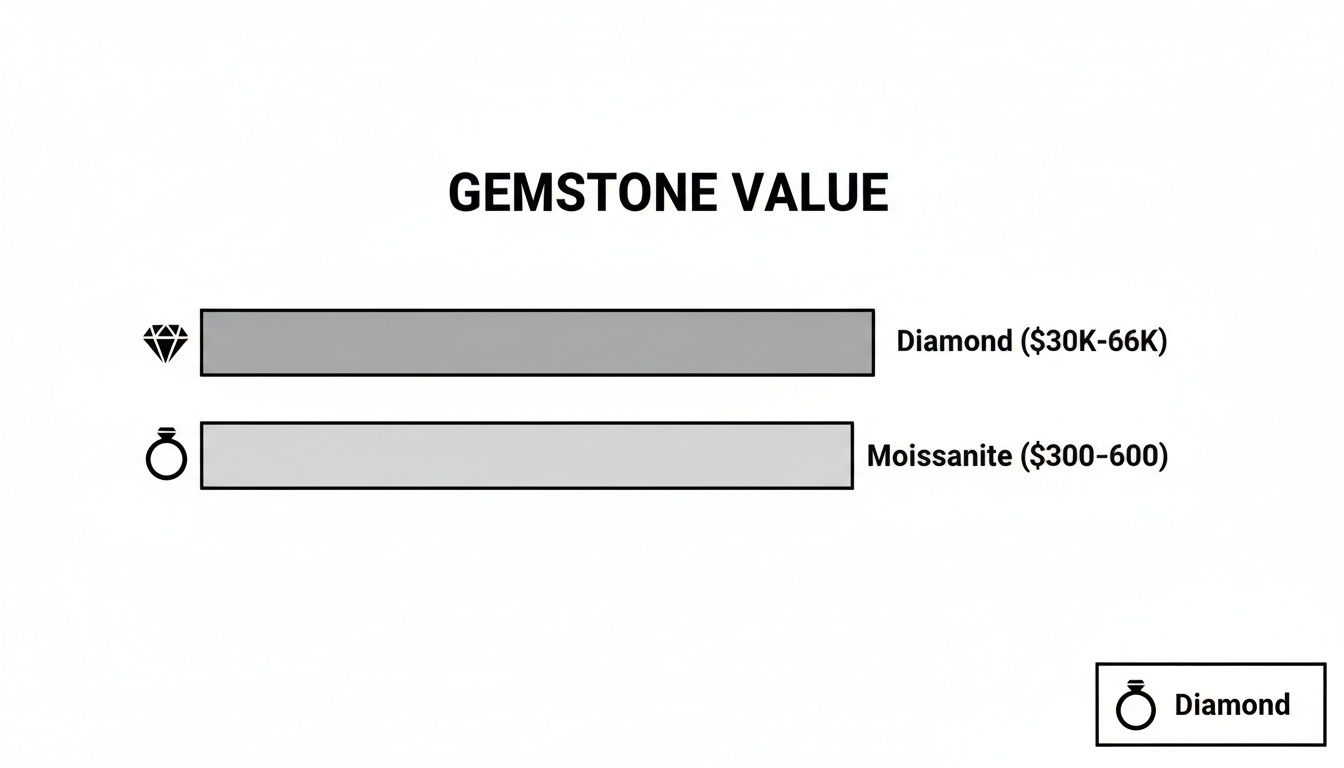
It’s easy to see how moissanite delivers incredible beauty without the extreme financial or ethical baggage of traditional gems.
Voting for a Better Industry
At the end of the day, choosing a lab created moissanite is a vote for a more responsible jewelry industry. You're supporting innovation that puts both human well-being and the planet's health first.
By choosing moissanite, you are ensuring that your beautiful gemstone is genuinely guilt-free. It is a symbol of love that reflects modern values of compassion and responsibility, aligning perfectly with a future-focused mindset.
Every stone from our collection at Moissanite Diamond comes with this guarantee of ethical integrity. If you'd like to dive deeper, we have a detailed guide explaining why moissanite is the ethical choice for modern jewelry lovers.
How to Choose and Care for Moissanite Jewelry
Choosing your perfect piece of moissanite jewelry is all part of the fun, and knowing a few key details can make the experience even better. While you might have heard of the "4 Cs" for diamonds (Cut, Color, Clarity, and Carat), they don't quite apply the same way to moissanite, mainly because it's engineered for perfection from the start.
With moissanite, Cut is everything. Seriously, it's the single most important factor. A masterfully cut stone is what unleashes that legendary, fiery sparkle moissanite is famous for. You don't have to worry much about Color or Clarity, because high-quality moissanite is already crafted to be colorless and clean to the naked eye. This lets you put all your focus on finding a cut that speaks to you and a carat size that fits your vision.
As you shop, make sure you're buying from a trusted jeweler who provides a certificate of authenticity. This is your assurance that you're getting a real, high-quality moissanite gem and not a simulant like cubic zirconia, which just doesn't compare in durability or brilliance.
Keeping Your Moissanite Brilliant
The good news? Keeping your moissanite looking incredible is surprisingly easy. Its surface naturally repels dirt and oil, so it stays clear and brilliant without much effort. For a quick clean, just give it a gentle bath in some warm water with a little mild soap and use a soft toothbrush to bring back its full sparkle.
This gem’s toughness is a huge part of its appeal. It scores a 9.25 on the Mohs scale of hardness and boasts a yield strength of 9 GPa, making it more than ready for everyday life—even more so than sapphire. In stress tests, it's been shown to chip 50% less than princess-cut diamonds. Plus, its rainbow fire is off the charts, returning light 2.3 times more effectively than a diamond.
When you're not wearing it, store your moissanite jewelry by itself. Tucking it into a soft pouch or a fabric-lined jewelry box will keep harder stones, like diamonds, from accidentally scratching its surface.
Thanks to its incredible hardness and simple care routine, your lab-created moissanite is truly made for a lifetime of wear. Follow these simple tips, and it will stay just as dazzling as the day you got it. For more in-depth advice, check out our complete guide on how to care for your moissanite jewelry so it lasts a lifetime.
Common Questions About Lab-Created Moissanite
It's completely normal to have a few questions before deciding on a lab-created moissanite. This is a big decision, and you deserve to feel completely confident in your choice. We get these questions all the time, so we’ve put together some clear, straightforward answers to help you out.
Will It Look Fake or Get Cloudy?
Not a chance. High-quality lab-created moissanite is built to last a lifetime. Thanks to its incredibly stable chemical structure, it will never get cloudy, fade, or lose that signature sparkle.
It’s a common worry, mostly because of less durable diamond look-alikes like cubic zirconia. But moissanite is in a league of its own—a genuine gemstone engineered to maintain its brilliance with just some simple, routine cleaning.
The fear of a cloudy stone is really a holdover from older, less stable diamond alternatives. Modern moissanite is a completely different material, designed to be as enduring as it is beautiful, ensuring it will look stunning for generations.
Can People Tell It's Not a Diamond?
Honestly, it's highly unlikely. To the naked eye, even a professional jeweler would have a tough time telling a quality moissanite from a diamond without specific tools.
The biggest giveaway—if you can call it that—is moissanite’s fiery, rainbow-like sparkle. It's more colorful and vibrant than a diamond's, which many people actually prefer. It gives you a show-stopping look that often gets mistaken for a very high-end diamond.
Ultimately, what people will see is a brilliant, beautiful gemstone. Whether they can pinpoint its unique fire as moissanite is another story, and for many, that extra sparkle is part of the appeal.
Is Moissanite a Good Choice for an Engagement Ring?
It's an absolutely fantastic choice. Moissanite is one of the toughest gemstones on the planet, rating a 9.25 on the Mohs scale of hardness. For context, a diamond is a perfect 10. This means it’s incredibly resistant to scratches and chips, making it perfect for a ring you’ll wear every single day.
When you factor in its durability, jaw-dropping sparkle, ethical sourcing, and amazing value, moissanite really stands out. You can get a much larger, more brilliant stone for your budget without ever sacrificing quality or worrying about it lasting. It’s a smart, stunning, and conscientious choice that beautifully represents a modern love story.
Find the perfect symbol of your love at Moissanite Diamond. Explore our breathtaking collections of ethically crafted moissanite rings, earrings, and pendants designed to last a lifetime. Shop now and discover your forever piece.