
Shopping for a beautiful ring online—especially something as significant as a stunning Moissanite engagement ring—is an incredible experience. But let's be honest, figuring out the right size can feel like a shot in the dark.
The good news? You can get a surprisingly accurate measurement right from your couch.
Find Your Perfect Ring Size Without Leaving Home
This guide is here to take the guesswork out of the equation. We’ll walk through the same reliable methods jewelers often recommend, using simple things you already have around the house. Forget the anxiety of ordering the wrong size and dealing with returns; we want you to have the confidence to find a ring that feels like it was made just for you.
With online shopping becoming the new normal, knowing how to measure your ring size is a crucial skill. Online jewelers now represent a huge slice of the market—an estimated 20% to 25% of all jewelry sales globally. This shift puts the power (and the tape measure) in your hands. But it also means that sizing mistakes are common, with some reports showing return rates as high as 30% for jewelry bought online due to sizing errors alone.
Why Nailing the Right Size is So Important
Getting the fit right is about so much more than just convenience. It’s about the joy of unboxing a piece of jewelry and having it slide on perfectly.
A ring that fits just right feels secure, comfortable, and becomes an effortless part of your daily life. An incorrect size, on the other hand, just leads to frustration.
- The Disappointment Factor: There’s nothing quite as deflating as getting that ring you’ve been dreaming of, only to find it’s too tight to wear or so loose it spins around your finger.
- Unexpected Costs: Resizing isn't always cheap, and for some designs, like eternity bands or rings with intricate details, it might not even be possible.
- The Risk of Loss: This is the big one. A ring that's too loose can slip off without you even noticing. It’s a heartbreaking and completely avoidable situation.
Taking a few minutes to measure correctly from the start ensures your buying experience is exciting and stress-free. This is especially true when you're choosing a forever piece, like an engagement ring made from a brilliant and durable gem like Moissanite. If you're new to this incredible stone, you might find our article on what Moissanite is helpful in understanding why it's such a popular choice.
Our goal is simple: to give you the confidence you need so you can focus on what really matters—finding that perfect design.
Four Proven Methods for At Home Ring Sizing
So, how do you actually measure your ring size without leaving the house? It’s easier than you might think, and you probably have everything you need lying around. I'm going to walk you through four reliable methods that we often suggest to people starting their search.
Each technique has its pros and cons. My advice? Try at least two different methods. If the results match up, you can be pretty confident you’ve nailed your size.
The String or Paper Strip Method
This is the classic DIY trick for a reason—it’s incredibly simple. All you need is a non-stretchy piece of string, dental floss, or a thin strip of paper, plus a pen and a ruler with millimeter markings.
First, wrap the string or paper snugly around the base of your finger. You're looking for a fit that's firm but doesn't press into your skin. A good rule of thumb is to make it tight enough that it won’t fall off, but loose enough to just barely slide over your knuckle.
Once it feels right, use a fine-tip pen to mark the exact spot where the end overlaps. This part is critical. A thick or shaky line can easily throw your measurement off by a half-size. After you've made your mark, lay the string or paper flat against a ruler and note the length in millimeters. You can then use this measurement with an international ring size chart to find your size.
Getting this right from the start saves a ton of hassle. As you can see below, sizing errors are a major reason for returns when buying rings online, turning what should be an exciting moment into a frustrating back-and-forth.
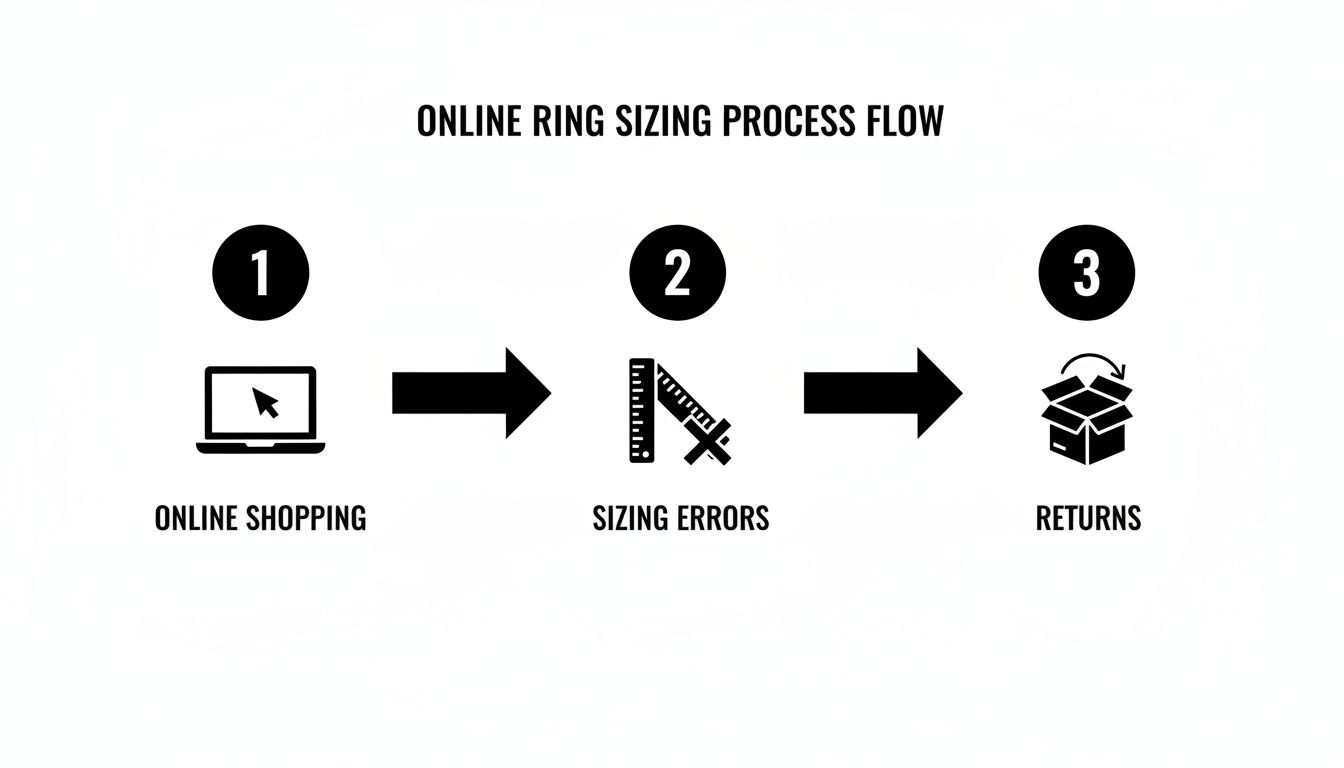
A simple mistake at home can lead to the headache of returns and exchanges, which is why taking your time with these steps is so important.
Using a Ring You Already Own
Have a ring that already fits that finger perfectly? Great, you can use it as a reference. This is often more reliable than the string method because you're starting with a solid, perfectly round shape.
Just grab a ruler with millimeter markings. Lay your ring on a flat surface and carefully measure its internal diameter—that’s the distance straight across the inside of the band, from one side to the other. Make sure you’re only measuring the empty space and not including the thickness of the metal itself.
With the diameter in millimeters, you can easily look up the corresponding size on a chart. One thing to keep in mind: this works best if your reference ring has a similar band width to the one you want to buy. A super-wide "cigar band" will fit differently than a delicate, thin band.
Trying a Printable Ring Sizer
Many online jewelers, including us, offer printable ring sizers. They're surprisingly effective, but only if you use them correctly. These tools usually come in one of two styles: a strip you cut out and wrap around your finger, or a chart of circles that you match to an existing ring.
The absolute most important step here is printing it to the correct scale. When you go to print, make sure your printer settings are at 100% scale, not "fit to page" or any other automatic setting. Most printable guides include a small line or box to measure with a ruler to confirm it printed correctly.
If that reference line doesn't measure up perfectly, stop right there. Your results will be off. It’s a tiny detail that makes all the difference between a perfect fit and a disappointing one.
Once you’ve triple-checked the scale, just follow the instructions on the sheet. It's a quick and easy way to get a reliable measurement.
Creating a DIY Mandrel
If you’re the type who likes to be extra sure, you can create your own version of a jeweler's mandrel at home. This is especially helpful if you’re using an existing ring as your guide.
Find something with a smooth, cone-like shape—a thick marker, a tapered candle, or even a tightly rolled-up piece of cardstock can work. Slide your ring down the object until it stops naturally without being forced.
Now, take a sharp pencil and carefully trace a line around both the top and bottom edges of the ring. After you slide the ring off, use your millimeter ruler to measure the diameter of the cylinder right where the ring was sitting. This gives you a really stable diameter measurement to compare against a size chart.
Comparing Home Ring Sizing Methods
To help you decide which approach is best for you, here’s a quick rundown of the four methods we just covered.
| Method | Accuracy Level | Tools Required | Best For |
|---|---|---|---|
| String or Paper | Moderate | String/paper, pen, ruler | Quick estimates or if you have no existing rings. |
| Existing Ring | High | A well-fitting ring, ruler | Confirming your size with a trusted reference. |
| Printable Sizer | High | Printer, ruler, scissors | A reliable measurement if printed to the correct scale. |
| DIY Mandrel | Very High | Tapered object, ring, pencil, ruler | Getting a very precise diameter from an existing ring. |
Each method has its place. For a quick check, the string method is fine. But for a more confident measurement, especially for an important purchase, using an existing ring or a properly printed sizer is the way to go.
Insider Tips for an Accurate Measurement
Getting your ring size right involves a bit more nuance than just wrapping a string around your finger. Think about it—our fingers aren't static. They subtly swell and shrink throughout the day based on everything from the temperature and what we've eaten to how active we are. Nailing these little details is the secret to finding a ring that feels like it was made just for you.
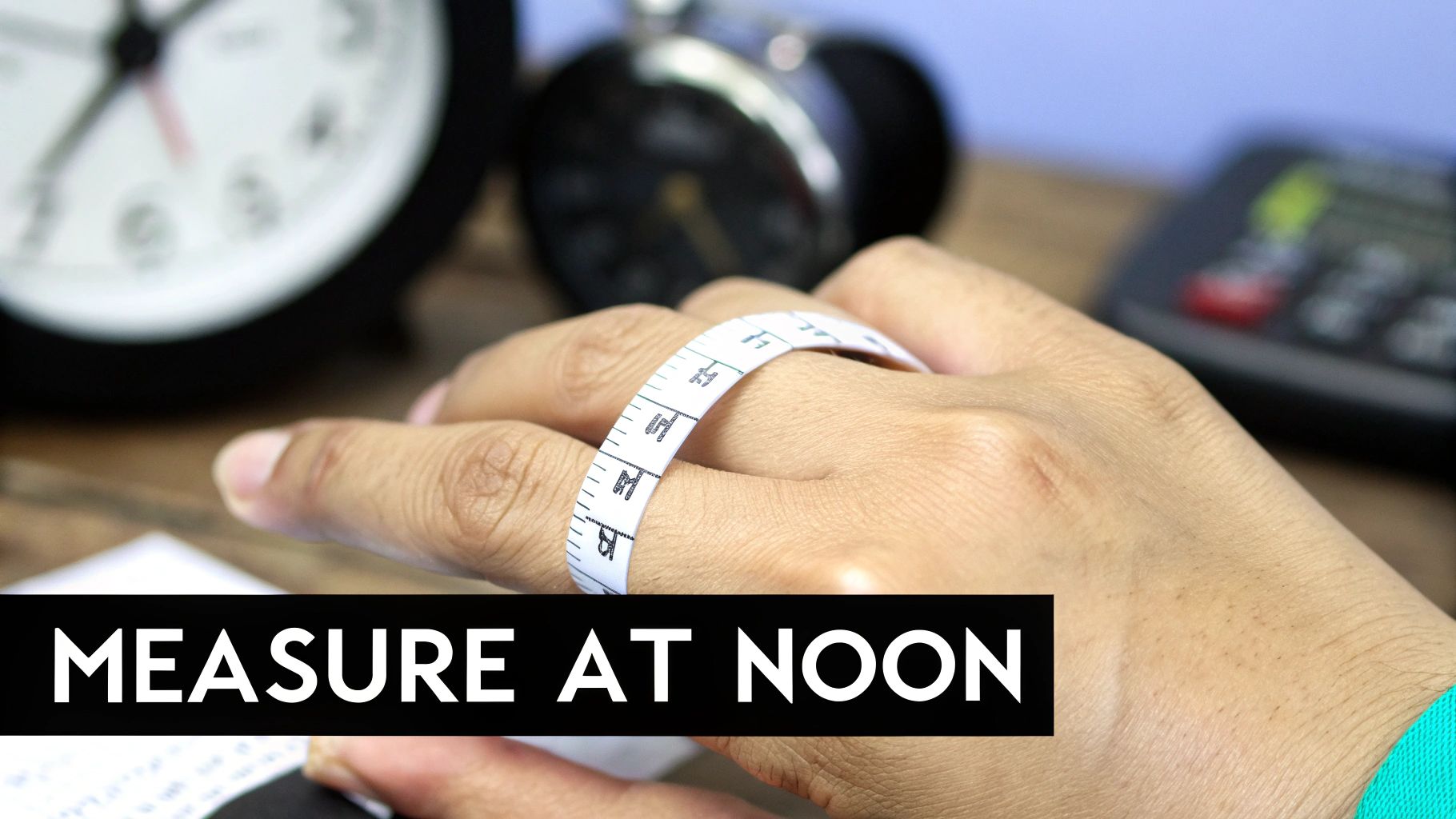
For the most accurate reading, try measuring in the middle of the day when you’re at a comfortable room temperature. I've found that fingers are often a little smaller first thing in the morning and can swell later in the evening or after a workout. Definitely avoid measuring when your hands are cold—that can easily give you a measurement that's up to a half-size too small.
Considering the Ring Band Width
Here’s something people often forget: the width of the ring band itself. This one detail can completely change how a ring fits, and it’s something you absolutely need to consider when you measure your ring size at home.
It’s a lot like clothing. A thick, chunky sweater is going to feel much tighter than a thin t-shirt, even if they're both labeled as the same size. Rings work the same way. A wider band takes up more real estate on your finger, which means more friction and a snugger feel.
- For thin bands (under 3mm): Your standard measurement should work perfectly fine.
- For wide bands (6mm or more): I always recommend going up by a quarter or even a half-size.
This simple adjustment makes all the difference. It stops the ring from feeling tight or creating that dreaded "muffin top" on your finger, ensuring it’s comfortable enough for everyday wear. This is especially true for bold statement pieces or substantial wedding bands.
Planning a Surprise Engagement
Trying to find out your partner’s ring size without blowing the surprise is a classic dilemma. The key here is to be subtle. If your partner already wears rings, you can secretly borrow one they wear on their left ring finger and measure it using one of the methods we covered, like the printable chart or measuring the internal diameter.
No rings in their jewelry box? Time to call in a trusted friend for a bit of espionage. A friend could casually suggest trying on rings for fun while out shopping and then report the size back to you. It feels far more natural and raises fewer suspicions. For more ideas on crafting that perfect moment, take a look at our guide on how to design an engagement ring that captures your unique story.
The need for reliable at-home sizing methods has exploded along with the online jewelry market. It's a huge industry—the global finger ring market is projected to hit 38.6 million units by 2025. And while common sizes like 6 and 7 are top sellers, what really counts is getting an accurate size for you. That’s the key to a purchase you’ll be happy with for years to come.
Avoiding Common Sizing Mistakes
Even with the best intentions, it's surprisingly easy for a small mistake to throw off your entire measurement. Knowing the common pitfalls ahead of time is your best defense against the disappointment of getting a ring that just doesn't fit. Let’s walk through the most frequent errors I've seen over the years and, more importantly, how to sidestep them.
One of the biggest culprits is simply using the wrong materials. While grabbing a piece of string seems like a no-brainer, many types have a bit of stretch. Using anything elastic—like yarn, a rubber band, or even some craft strings—is a recipe for a bad fit. It will almost always give you a measurement that’s too small, leaving you with a ring that's painfully tight.
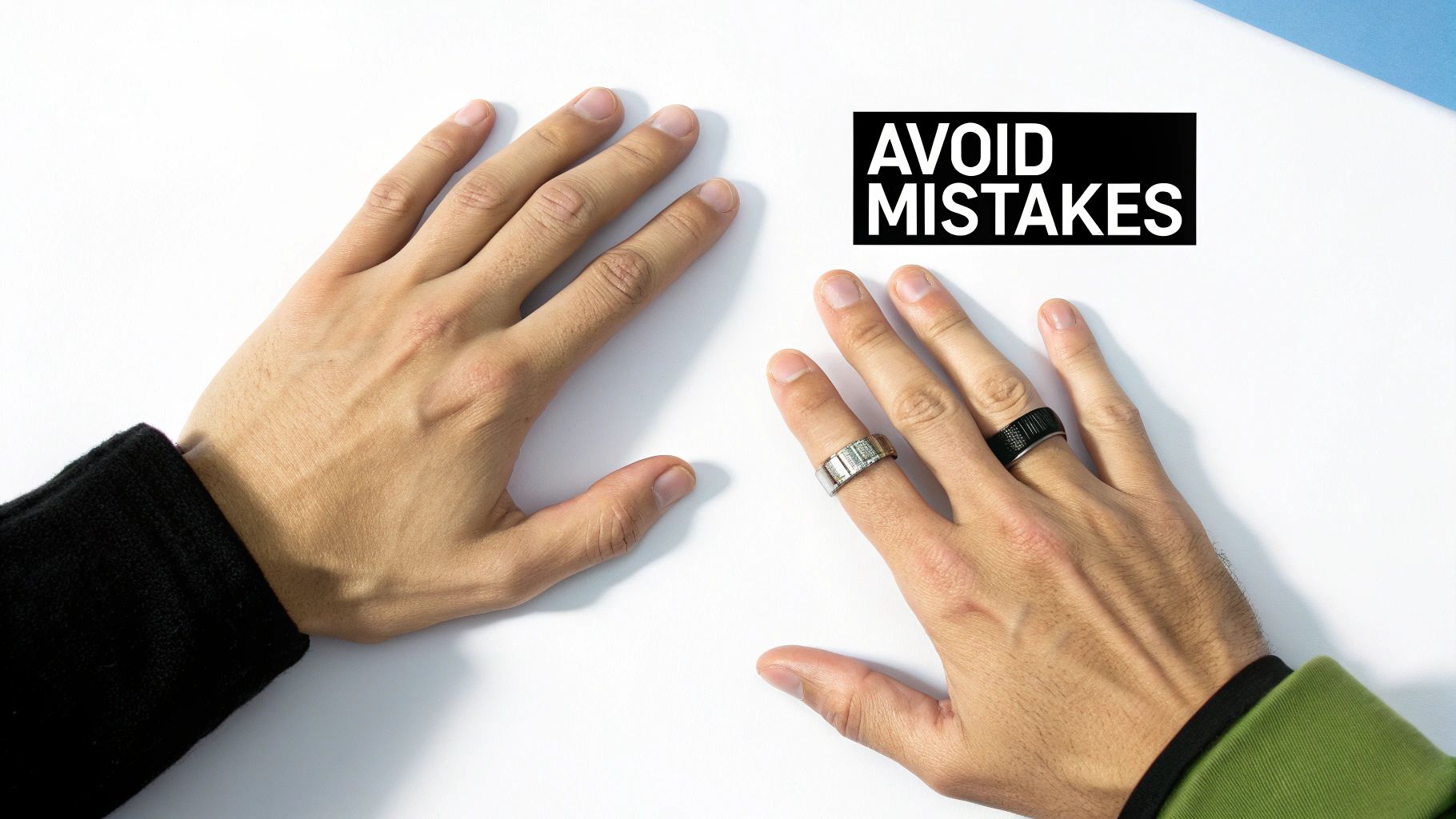
Stick to something with zero give. Dental floss or a crisp, non-stretchy strip of paper will give you a much more honest measurement.
Forgetting About Your Knuckle
This is a huge one. It's so easy to focus on getting that perfect, snug fit at the base of your finger that you completely forget the ring has to make it over the knuckle first.
If your knuckles are larger than the base of your finger—which is true for a lot of people—you have to account for it. The goal is a ring that's snug enough not to fall off but still loose enough to slide over your knuckle with a gentle twist.
Your ideal ring size is often a compromise between the size of your knuckle and the base of your finger. It's better for a ring to be slightly loose at the base than to be impossible to put on or take off.
Measuring at the Wrong Time
As we mentioned earlier, timing really matters. Your fingers can swell and shrink quite a bit throughout the day depending on temperature, what you've eaten, and your activity level.
- The Mistake: Measuring first thing in the morning when you wake up or when your hands are ice-cold.
- Why It's a Problem: Cold fingers are at their smallest. A ring sized for a cold finger will feel suffocating once you warm up.
- The Fix: Always measure in the afternoon or evening when you're at a comfortable room temperature. This gives you the most stable and realistic reading.
Misreading the Measurement
When you mark your paper strip or string, that tiny pen mark can make a world of difference. A thick, fuzzy line can easily add or subtract a half-size. The same goes for lining it up against the ruler—make sure you start right at the zero mark and read the millimeters precisely.
Double-check your work. Seriously. Then, do it one more time. Taking an extra 30 seconds to confirm your measurement can save you from the hassle and expense of a resizing down the road. This final check is the last step in mastering how to measure ring size at home with total confidence.
Shop with Confidence at Moissanite Diamond
Now that you know how to find your ring size right from your own home, you can shop with total confidence. Our whole goal at Moissanite Diamond is to make sure your experience is as brilliant as our jewelry, and this guide is a big part of that. We want you to feel secure and, most of all, excited about your purchase.
We also get it—even with the best at-home methods, you might still have that little bit of doubt or just want a second opinion. That’s completely normal! It's exactly why our customer support team is here. They’re great at helping you double-check your measurements and can offer specific advice based on the ring style you’ve got your eye on.
Our Commitment to Your Perfect Fit
Your peace of mind is what matters most to us. We stand behind the quality of every single piece we make, and that’s why we have a straightforward, no-fuss return and exchange policy.
Think of this policy as your safety net. If your ring arrives and it’s not quite right, you're not stuck. We’ve made the process simple so you can get the correct size without any stress.
Choosing a Moissanite ring is about celebrating a special moment, a lifelong commitment, or a personal milestone. It should be a joyful process, not one filled with anxiety over getting the size right.
At the end of the day, we want you to absolutely love your ring and wear it proudly for years. Whether you're planning a surprise proposal or picking out a beautiful piece for yourself, like our stunning Devachi Engagement Ring, we’re here to help you every step of the way. Consider us your partner in finding that perfect, unforgettable piece of jewelry.
Common Ring Sizing Questions Answered
Even after you've measured carefully, a few lingering questions can make you second-guess your decision. That’s perfectly normal, and we get these questions all the time. Let's clear up those last few uncertainties so you can feel completely confident in your choice.
What if I’m Between Two Sizes?
It happens all the time—your measurement lands right in the middle of two standard sizes. So, what’s the right move?
When in doubt, it’s almost always better to size up to the next half-size. A ring that's a tiny bit loose is far more comfortable and manageable than one that's painfully tight. If it ends up feeling a little too loose, a jeweler can easily add small sizing beads inside the band for a snugger fit, which is a much simpler fix than a full resize.
Think about it: your fingers naturally swell with changes in temperature, humidity, or even after a salty meal. That little bit of extra room can be a lifesaver, ensuring your ring remains comfortable year-round.
How Do I Adjust for a Wide Band?
This is such an important question, and it's one that many people don't think about until it's too late. The width of the band dramatically changes the fit. A wider ring covers more of your finger, which means more friction and a much tighter feel, even if it's technically your correct size.
Here's a good rule of thumb:
- For bands 6mm or wider: Plan on going up a quarter or even a half-size from what you normally wear.
- For very wide bands (8mm and up): Sizing up a full half-size is usually the safest bet.
This simple adjustment makes all the difference, preventing that tight, constricted feeling and making sure the ring can actually slide over your knuckle without a struggle.
Can the Ring Be Resized Later On?
Whether a ring can be resized really comes down to its style and material. For a simple, plain band made of gold or platinum, a good jeweler can typically adjust it up or down a size or two without any issue.
However, some designs are much trickier, or even impossible, to resize:
- Eternity Bands: With gemstones wrapping all the way around, there's no plain metal to work with. Resizing would mean completely rebuilding a section of the ring and its settings.
- Intricate Patterns: Detailed engravings or milgrain that circle the entire band can get warped, stretched, or broken during the resizing process.
This is why getting the size right from the get-go is so crucial, especially if you have your heart set on one of these more complex styles.
At Moissanite Diamond, our goal is to help you find a ring that feels like it was made just for you. We’re here to help every step of the way. Shop now at Moissanite Diamond and discover a piece you'll love for a lifetime.