
When you get right down to it, the diamond vs moissanite conversation is really about two things: what they're made of and how they sparkle. Diamonds are pure carbon, known for that classic, balanced white sparkle. Moissanite, on the other hand, is silicon carbide and throws off an intense, fiery rainbow flash. Your choice really boils down to whether you lean toward timeless tradition or brilliant, modern value.
The Modern Choice in Fine Jewelry
Picking out an engagement ring or a signature piece of jewelry isn't the straightforward decision it once was. For centuries, the diamond was the undisputed champion, a symbol of love, commitment, and status. But today's buyer is different. They're looking beyond just tradition—they want value, ethical peace of mind, and a stone that genuinely speaks to their style.
That's where moissanite steps into the ring. It's not trying to be a diamond "substitute," but a stunning, scientifically brilliant gemstone in its own right.
Natural moissanite was first discovered in a meteor crater, which sounds cool, but it's far too rare to be used in jewelry. The moissanite you see today is created exclusively in a lab. This guarantees it's 100% conflict-free and environmentally sound, a modern origin story that really resonates with people who want their jewelry to reflect their values.
Key Factors to Consider
Before we dive deep, let's break down the main things that set these two stones apart. These are the details that will ultimately shape your decision.
- Brilliance and Fire: This is all about how a stone plays with light. Brilliance is the return of white light, while fire is the prism-like effect that creates rainbow flashes.
- Durability: How well a gem will hold up to the knocks and scrapes of everyday life.
- Cost and Value: The real-world price difference for stones that look similar in size and quality.
- Ethical Sourcing: The story behind the stone—its impact on the environment and the people who mine it.
Moissanite makes a powerful case for itself. You get the look and toughness of a premium gemstone, but without the ethical questions or the eye-watering price tag of many diamonds. It’s a perfect example of a shift toward smarter, more responsible luxury.
Here's a quick look at the core differences we’ll cover in this guide. Think of this as a cheat sheet to get you started on the key distinctions in the diamond vs moissanite debate.
| Characteristic | Diamond | Moissanite |
|---|---|---|
| Composition | Carbon | Silicon Carbide (SiC) |
| Hardness (Mohs) | 10 (The Hardest) | 9.25 (Extremely Durable) |
| Sparkle | Balanced Brilliance & Fire | Intense "Rainbow" Fire |
| Origin | Mined or Lab-Grown | Exclusively Lab-Grown |
| Price | High | Significantly Lower |
A Side-By-Side Gemstone Comparison
When you're trying to choose between a diamond and a moissanite, a side-by-side look at what makes them tick is the best place to start. They can look surprisingly similar at first glance, but beneath the surface, each stone has its own distinct personality shaped by its chemical makeup, how it handles light, and where it comes from. This is our foundational overview before we dive deeper into the fun stuff, like sparkle and durability.
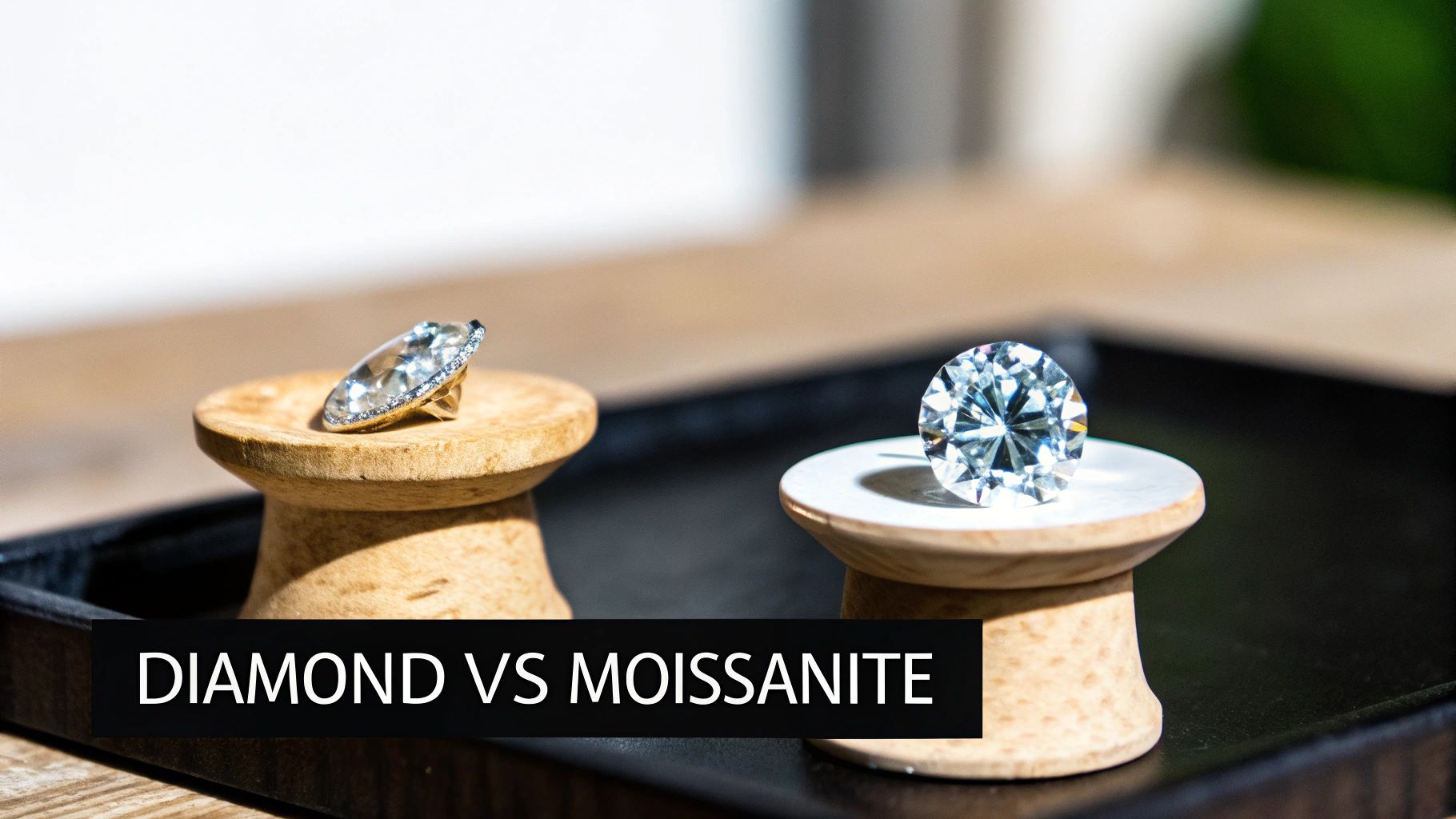
At its core, a diamond is pure, crystallized carbon—famous for being the hardest material on earth and for its classic, balanced sparkle. Moissanite, on the other hand, is made from silicon carbide (SiC). This different composition is the very reason it sparkles with a more intense, fiery brilliance. Every other difference between them stems from this one simple fact.
Quick Comparison Diamond vs Moissanite
To make things easy, here’s a quick-reference table that cuts right to the chase. It lays out the most important differences between natural diamonds and lab-created moissanite, helping you see the trade-offs and advantages at a glance.
| Characteristic | Diamond | Moissanite |
|---|---|---|
| Composition | Carbon | Silicon Carbide (SiC) |
| Hardness (Mohs) | 10 (Hardest known mineral) | 9.25 (Extremely durable for daily wear) |
| Brilliance (White Light) | High (Refractive Index: 2.42) | Very High (Refractive Index: 2.65) |
| Fire (Rainbow Flashes) | Moderate and balanced | Intense and fiery, often called the "disco ball effect" |
| Origin | Mined from the earth or lab-grown | Exclusively created in a laboratory |
| Color | Graded D-Z (colorless to light yellow) | Graded to appear colorless or near-colorless |
| Cost | Significantly higher per carat | A fraction of the cost for a similar size |
This table really gets to the heart of the matter. With a diamond, you’re investing in tradition, the rarity of a natural stone, and unparalleled hardness. Moissanite offers a modern, ethical, and budget-friendly alternative that delivers a huge, brilliant gemstone with show-stopping fire.
The decision often comes down to personal preference in sparkle. A diamond offers a classic, crisp combination of white light and subtle colored flashes, while moissanite delivers a vibrant, high-energy rainbow of light that is impossible to miss.
Origin and Value Proposition
The origin story of each stone really shapes its value and appeal. Mined diamonds have a rich history, but they also carry ethical and environmental baggage that many modern buyers are looking to avoid. Both lab-grown diamonds and moissanite are guaranteed conflict-free, but moissanite stands in its own category because of its unique chemical makeup.
Since every moissanite is created in a lab, its supply is predictable, and its price isn't tied to the high costs of mining. This means you can get a visually stunning and incredibly durable stone without the premium price tag. The growing popularity of moissanite is clear from its market performance. Valued at $85.2 million in 2021, the global moissanite market is set for continued growth as more people learn about its affordability and brilliance. You can discover insights into the moissanite market report on cognitivemarketresearch.com to learn more about these trends.
Ultimately, your choice depends on what matters most to you. Are you drawn to the timeless legacy and subtle sparkle of a diamond, or does the dramatic fire, ethical peace of mind, and outstanding value of a moissanite win you over?
Comparing Sparkle, Fire, and Brilliance
Place a diamond and a moissanite next to each other, and the first thing you’ll notice is the way they handle light. This is where their personalities really shine through. While both stones are incredibly bright, they "speak" in different visual languages, a crucial point in the diamond vs moissanite debate.
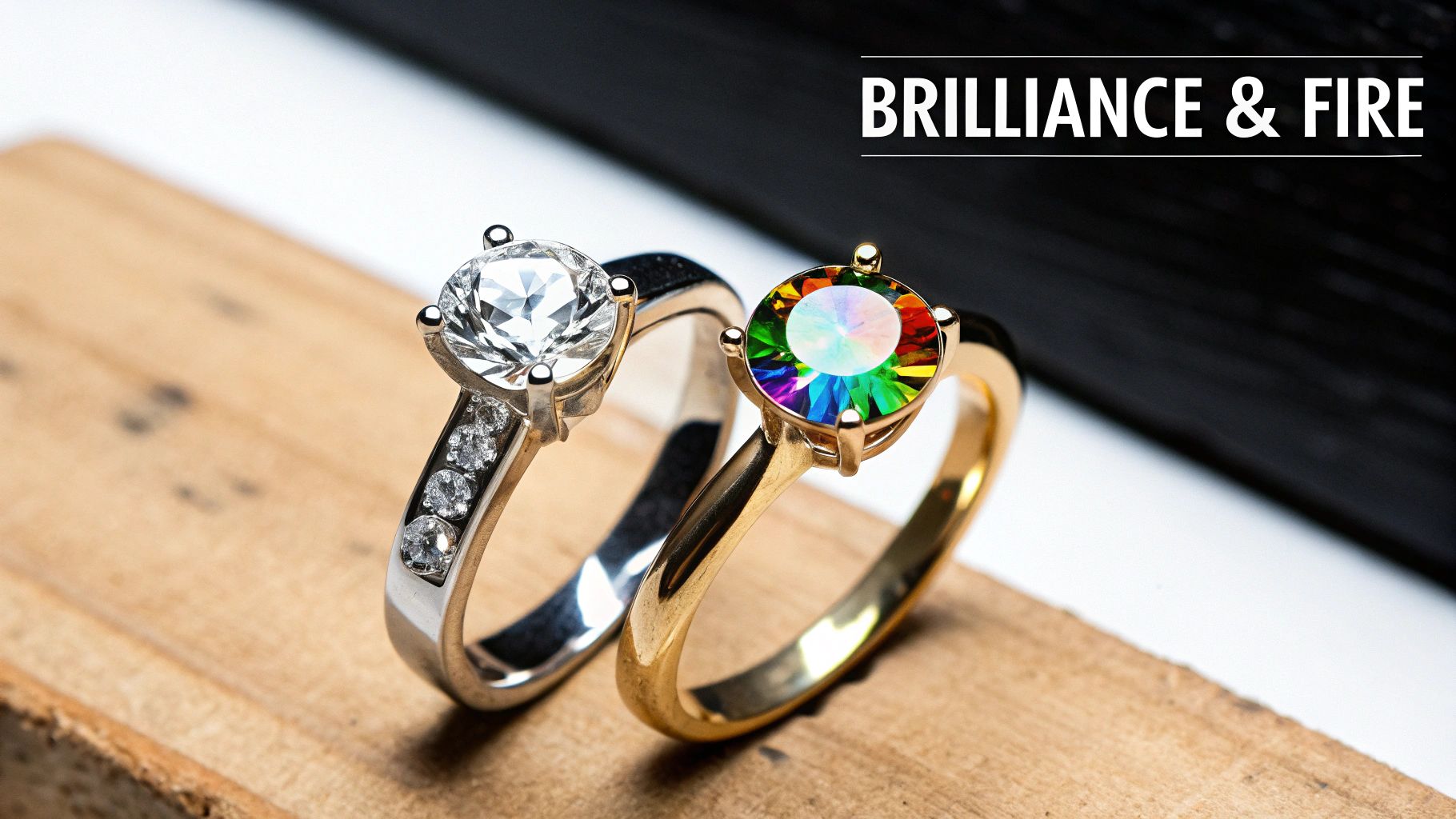
To really get what's happening, you need to understand three things: brilliance, fire, and scintillation. Each stone has its own strength, and figuring out which one you prefer is the key to making the right choice.
What Are Brilliance and Fire?
Brilliance is all about the white light. Think of it as the bright, crisp sparkle that a gemstone returns to your eye. A well-cut stone is like a tiny house of mirrors, designed to grab any available white light and shoot it right back out the top.
Diamonds are the undisputed champions of balanced brilliance. Their internal structure is singly refractive, which means light travels through in a straight, clean line. Combine that with a Refractive Index (RI) of 2.42, and you get that classic, elegant diamond sparkle—a deep, mesmerizing return of white light.
Moissanite, on the other hand, kicks things up a notch. Its RI is a higher 2.65, so it actually bends light more aggressively than a diamond. This gives it an intensely bright appearance, but that's only half the story.
The Famous Moissanite "Fire"
Where moissanite truly puts on a show is with its fire. This is a gem's ability to act like a prism, splitting white light into a full-blown rainbow of colors. This is the effect that creates those dazzling, colorful flashes you see when the stone moves.
Moissanite’s fire is off the charts—its dispersion rating is more than double that of a diamond. This creates an electrifying display of rainbow light, often called the "disco ball" effect. It's a vibrant, fiery personality that is impossible to miss and is one of the stone’s most celebrated traits.
A diamond’s fire is more restrained. It produces beautiful, distinct flashes of color, but they are more subtle and work in harmony with its white light brilliance. It's like comparing a stunning fireworks display to the elegant flicker of candlelight; both are captivating, but they create entirely different feelings.
Here's the bottom line: A diamond gives you a classic, sophisticated sparkle that perfectly balances brilliant white light and subtle flashes of color. Moissanite delivers a show-stopping, fiery performance packed with intense rainbow flashes that command attention.
The Science of Double Refraction
A key difference behind these visual effects is refraction. As we touched on, diamonds are singly refractive. Light goes in, and it comes out as a single, focused ray. Simple and clean.
Moissanite is doubly refractive. When light enters the stone, its internal structure splits that beam into two separate rays. This splitting action is a huge reason for its exceptional fire. Under a jeweler's loupe, you might even notice a slight doubling of the facets, but to the naked eye, this just amps up the stone's colorful sparkle.
This unique optical property is central to moissanite's identity. If you're curious about how this plays out in different environments, you can learn more about why moissanite sparkles differently in every lighting condition from our in-depth guide.
Which Sparkle Fits Your Style?
Ultimately, this comes down to what you love to look at. There's no "better" option here, just the one that makes your heart skip a beat.
-
You might be a Diamond person if: You gravitate toward timeless, classic elegance. You want a sophisticated sparkle that blends brilliant white light with tasteful pops of color. Your style is more understated and refined.
-
You might be a Moissanite person if: You love to make a statement. You're drawn to a bold, fiery sparkle that explodes with a rainbow of colors. You want a stone that captures everyone's attention.
For most buyers, this visual difference is the deciding factor. Both stones offer incredible beauty, but they tell two completely different stories with light. One whispers sophistication; the other shouts with joy. Only you can decide which one speaks to you.
Understanding Durability for Everyday Wear
An engagement ring is a forever piece, which means the gemstone at its heart has to be tough enough to handle everything life throws at it. When you're picking a stone you plan to wear day in and day out, durability isn't just a feature—it's a necessity.

The go-to standard for measuring a gemstone's toughness is the Mohs scale of mineral hardness. It ranks materials on a scale from 1 (the softest) to 10 (the absolute hardest). This isn't just an abstract number; it's a real-world test of how well a mineral can resist getting scratched.
Diamond: The Undisputed Champion of Hardness
Diamonds sit at the very top of the Mohs scale with a perfect 10. This isn't just one step above other gems; it's a massive leap. As the hardest known natural substance on Earth, a diamond is incredibly resistant to the kind of scratches and scuffs that come from daily life.
This is exactly why diamonds became the classic choice for engagement rings. They can handle accidental bumps against kitchen counters, scrapes against a car door, and everyday contact with other objects without losing that flawless, pristine surface.
Moissanite: An Exceptionally Tough Contender
Here’s where the diamond vs moissanite comparison gets really interesting. Moissanite clocks in at an impressive 9.25 on the Mohs scale. While it's second to diamond, that number makes it one of the hardest substances on the planet, tougher than other durable favorites like sapphire (9) or topaz (8).
So what does that 9.25 actually mean for you? It means moissanite is more than tough enough for an everyday ring. It will resist getting scratched by just about anything it could ever come into contact with.
Choosing moissanite doesn't mean you're compromising on longevity. Its 9.25 hardness rating ensures it will stand up to daily life and keep its brilliant surface for a lifetime, making it a reliable and practical choice for an engagement ring.
Real-World Durability Compared
Let's ground these numbers in reality. The Mohs scale is all about what scratches what. A mineral with a higher score will scratch anything with a lower score.
- Diamond (10): The only thing that can scratch a diamond is another diamond. Simple as that.
- Moissanite (9.25): While a diamond could scratch it, moissanite easily fends off scratches from common materials like steel, granite, and even quartz (which is found in sand and dust).
- Common Scenarios: Think about it—your moissanite ring won't get scuffed by keys jangling in your pocket, a bump against a metal doorknob, or a scrape on a brick wall. Its resilience is more than a match for an active lifestyle.
At the end of the day, both gemstones are incredibly durable. A diamond will always be the king of hardness, but moissanite is so exceptionally tough that for all practical purposes, it offers the same confidence and peace of mind for daily wear. This lets you focus on the factors that matter more to you, like sparkle and price, without ever having to worry if your stone will last.
Of course, keeping any piece of jewelry looking its best involves a little upkeep. You can find some great tips in our guide on how to care for your moissanite jewelry so it lasts a lifetime.
The Ethical and Financial Case for Moissanite
When you're choosing a gemstone, what you don't see is just as important as what you do. The story behind the stone—its origin and its journey to you—matters. This is where the diamond vs moissanite conversation gets really interesting, moving beyond sparkle and into two things that hit close to home for most of us: ethical responsibility and smart spending.
The diamond industry has a complex history, and while things have improved with programs like the Kimberley Process, it can still be tough to trace a diamond's path with absolute certainty. Environmental impact from mining is also a major concern for many.
Moissanite sidesteps these issues entirely.
Every single moissanite is grown in a controlled lab, which means its origin is perfectly clear. This process ensures every stone is 100% conflict-free and leaves a much smaller environmental footprint than traditional mining.
The Clear Advantage of a Lab-Grown Origin
Choosing a lab-created stone like moissanite just gives you peace of mind. There are no lingering questions about its past, no worries about ecological damage, and no concerns about unethical labor. From start to finish, it's a clean, responsible choice.
This ethical clarity is a huge reason moissanite has become so popular. People want to buy things that align with their values, and knowing your stone was sourced responsibly is a big deal. For a deeper dive, check out our article on why moissanite is the ethical choice for modern jewelry lovers.
You can see this shift in the market numbers, too. North America now represents about 45% of the global moissanite market. This trend is driven heavily by a younger generation that puts sustainability and ethics right up there with beauty and price, making them far more open to brilliant alternatives like moissanite. You can see more on these global moissanite market findings on persistencemarketresearch.com.
Unpacking the Financial Value Proposition
Beyond the ethics, the financial side of moissanite is just plain smart. It’s not about being a "cheaper" stone; it’s about getting incredible value and putting your money where it matters most to you.
A moissanite costs just a fraction of what a diamond of the same size and quality would. A one-carat, colorless, eye-clean diamond can run you thousands of dollars. A moissanite that looks identical could be less than a tenth of that cost.
This price difference frees you up to make decisions based on what you love, not just what you can afford. You can finally get that larger stone or that intricate setting you've been dreaming of without the budget anxiety.
Think about it: the significant savings mean you can invest more in the design and craftsmanship of the ring itself. Maybe that means upgrading to a platinum band or affording a custom setting from a designer you love—all because you chose a moissanite as your center stone.
Here’s what that looks like in the real world:
- Go Bigger: For the price of a modest one-carat diamond, you could easily get a stunning two or even three-carat moissanite. The result is a much more dramatic and impressive piece of jewelry.
- Get Top Quality: All moissanites are created to be visually flawless and colorless. You're getting a stone that meets the criteria for the highest, most expensive grades on the diamond scale, without the premium price tag.
- Free Up Your Budget: Those savings can go toward other big life moments—the wedding, a down payment on a house, or an unforgettable honeymoon.
Ultimately, moissanite gives you this incredible combination of ethical confidence and outstanding value. You get a gorgeous, durable, and brilliant gem that doesn’t just reflect light, but also reflects a commitment to making smarter, more responsible choices.
How to Choose the Right Gemstone for You
So, how do you make the final call? Choosing between a diamond and a moissanite is a deeply personal decision. There's no single "best" stone, only the one that feels right for you—the one that aligns with your budget, your personal values, and the kind of sparkle that truly makes you smile.
We've covered all the technical details, but now it's time to connect that knowledge to what you actually want. A few honest questions can cut through the noise and lead you straight to a choice you'll be happy with for years to come.
Your Personal Decision Checklist
Think of this as a quick gut check. Running through these points will help clarify what's most important and guide you toward either a classic diamond or a brilliant moissanite.
-
What Does Your Budget Look Like? Let's be real about the numbers. If getting the most impressive size and quality for your money is the main goal, moissanite is a game-changer. It lets you go for a larger, visually perfect stone for a tiny fraction of what a comparable diamond would cost.
-
What Kind of Sparkle Do You Prefer? This is all about your personal taste. Are you captivated by the timeless, balanced shimmer of a diamond, with its mix of white light and subtle fire? Or do you find yourself drawn to the dazzling rainbow flashes of moissanite that catch the light from every angle?
-
How Important Are Ethics and Sustainability? The story behind your stone matters. If knowing your gem is 100% conflict-free with a minimal environmental impact is a must-have, moissanite's lab-created origin offers total transparency and peace of mind.
Ultimately, the choice boils down to what you value most. A diamond represents tradition and classic beauty, while moissanite stands for brilliant value, ethical assurance, and a bold, fiery presence.
This flowchart can help you visualize the process, mapping out the choice based on your priorities.
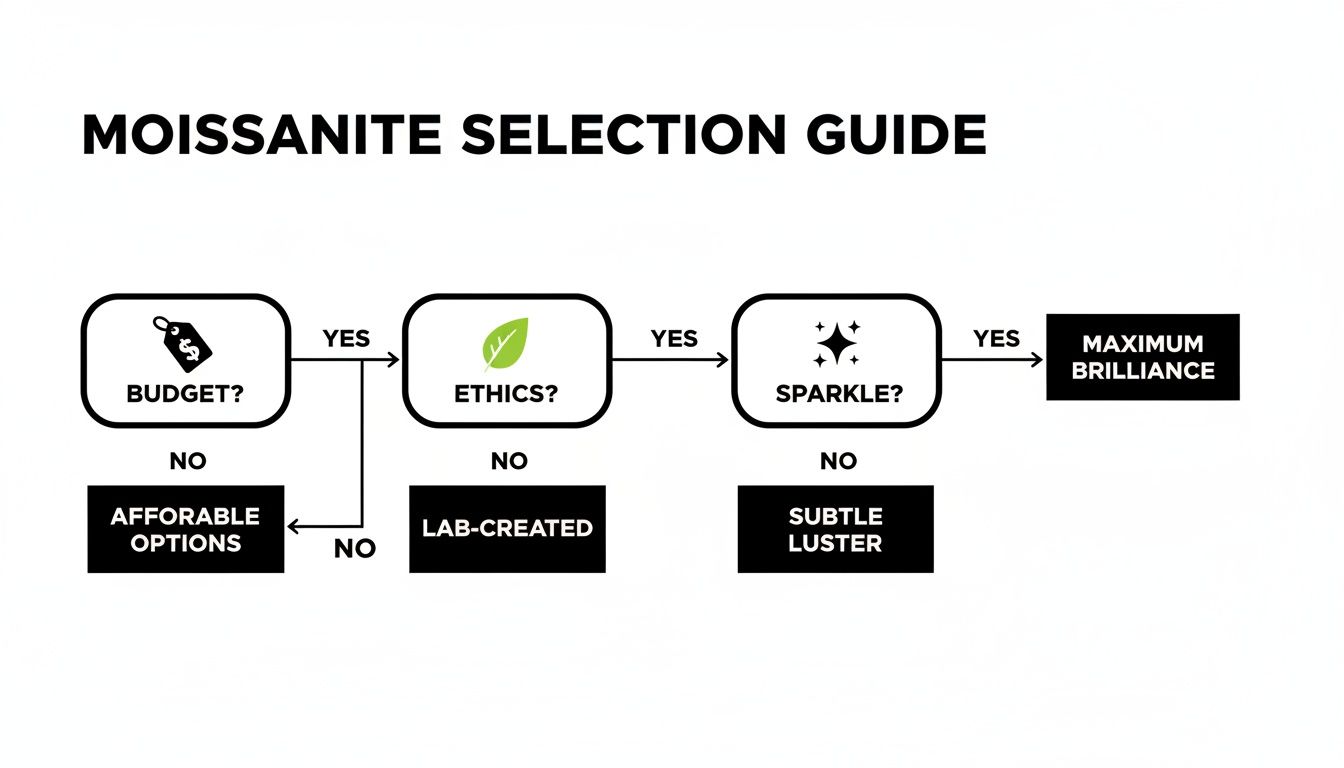
As you can see, if a smart budget, ethical sourcing, or a show-stopping sparkle are at the top of your list, moissanite becomes an incredibly powerful contender.
Making the Final Choice with Confidence
For today’s buyer who wants it all—breathtaking beauty, everyday durability, a clean conscience, and fantastic value—moissanite is tough to argue with. It's not about settling; it's about making a smart, informed choice for a gem that truly delivers. You can invest in a bigger, more dramatic stone without breaking the bank or second-guessing its journey to you.
If you love that intense, fiery sparkle and want a stone that reflects both light and a commitment to modern luxury, moissanite is the clear winner. It's a choice that feels as good as it looks, making it the perfect centerpiece for a lifetime of memories.
Got Questions About Moissanite?
It's completely normal to have a few lingering questions, especially when you're choosing a stone for a significant piece of jewelry. When it comes to the diamond vs moissanite debate, a few key questions come up time and time again. Let's tackle them head-on so you can feel confident in your decision.
We're here to clear up the confusion and show you why moissanite has earned its place as a brilliant, modern gemstone.
Is Moissanite a "Fake" Diamond?
This is probably the biggest misconception out there, and the answer is a firm no. Moissanite isn't a fake diamond or a cheap substitute like cubic zirconia. It's a completely separate gemstone with its own unique chemical structure—it's made of silicon carbide (SiC), while a diamond is pure carbon.
Think of it this way: a sapphire isn't a "fake" ruby. They're both just different, beautiful gemstones. Moissanite stands on its own as a durable and valuable stone celebrated for its incredible fire.
Moissanite isn't trying to be a diamond. It's an entirely different gemstone that offers its own unique set of advantages, from its intense sparkle to its guaranteed ethical origin and remarkable value.
Will My Moissanite Get Cloudy or Turn Yellow?
Absolutely not. Modern, high-quality lab-grown moissanite is built to last. It's chemically stable, meaning it won't change color or lose its sparkle over time. Unlike older diamond alternatives, its brilliance is part of its core structure, not just a surface coating.
If your moissanite ever looks a little dull, it’s almost certainly just everyday buildup from things like lotion, soap, or natural skin oils. A quick, simple cleaning is all it takes to bring back that signature, fiery sparkle instantly.
Can Other People Tell It’s Not a Diamond?
Honestly, for the average person, telling the two apart just by looking is next to impossible. They look incredibly similar in terms of color and clarity. Even a trained jeweler might need a moment to spot the difference, usually by looking for moissanite's more intense, rainbow-like sparkle (its "fire"). A diamond’s sparkle is a bit more subtle and white.
In the real world, though, people will just see a stunning, high-quality gem on your hand. They'll notice its beauty, not question its origin.
What’s the Best Way to Care for Moissanite Jewelry?
Good news: caring for moissanite is just as easy as caring for a diamond. It's an incredibly tough stone, rating a 9.25 on the Mohs scale of hardness, which makes it resistant to scratches and perfect for everyday wear.
Keeping it clean is simple:
- Weekly Polish: A gentle scrub with a soft toothbrush and warm, soapy water is usually all it takes to remove daily grime.
- Deeper Clean: You can soak it in a commercial jewelry cleaner or have it professionally cleaned for an extra bit of sparkle.
- Chemicals to Avoid: While it’s tough, it’s always a good idea to take your ring off when dealing with harsh chemicals like chlorine or bleach.
With just a little bit of care, your moissanite will keep its dazzling fire for a lifetime, looking just as brilliant as the day you first put it on.
Ready to see the brilliance of moissanite for yourself? At Moissanite Diamond, we have a stunning collection of ethically crafted rings, earrings, and pendants that deliver incredible sparkle without compromise. Find a piece that truly reflects your style and values.