
Stunning, durable, and brilliant—the best diamond alternatives for engagement rings aren't just substitutes; they're exceptional choices in their own right. Gems like moissanite, lab-grown diamonds, and sapphires are winning over modern couples for a powerful mix of ethics, affordability, and personal style. It turns out, you don't have to compromise to find the perfect, lifelong symbol of your love.
Why Modern Couples Are Looking Beyond Mined Diamonds
Choosing an engagement ring today is so much more than just following tradition. It's a deeply personal decision that reflects a couple's values, financial priorities, and unique taste. For generations, a mined diamond was the undisputed king, but that's changing—fast.
Today's couples are savvy. They’re armed with information and want options that feel right for them. This shift isn’t about "settling" for something less. It’s about making a smarter, more conscious choice that aligns with a modern lifestyle.
The incredible quality of today's diamond alternatives for engagement rings gives couples real freedom. Instead of draining their savings for a smaller mined diamond, they can get a larger, more spectacular stone without the financial pressure. This practical mindset means more money for other big life goals, like a down payment on a house or an epic honeymoon, all without sacrificing the wow-factor of a beautiful ring.
The Perfect Blend of Beauty and Value
At the heart of this trend is the undeniable bang-for-your-buck you get with gems like moissanite and lab-grown diamonds. These aren't just "look-alikes"; they are magnificent jewels engineered for brilliance and built to last a lifetime. Moissanite, for example, is famous for its fiery, rainbow-like sparkle that many people find even more dazzling than a diamond's.
The price difference is honestly staggering, and it's one of the biggest reasons people are making the switch. For instance, a moissanite stone that looks identical to a 2-carat diamond might run you $600 to $1,200. A mined diamond of the same size and quality? You could easily be looking at $10,000 or more. That’s a potential saving of up to 94% for the same visual impact.
It's no surprise that with numbers like these, consumer reports show 68% of buyers are now seriously considering non-traditional options for their engagement rings.
A Clear Conscience for a Modern Love Story
Beyond the budget, ethics are a huge deal. Let's face it, the history of diamond mining is complicated, and many couples just don't want to worry about conflict stones or the heavy environmental toll. Lab-created gems offer a clean, worry-free alternative.
Choosing a lab-grown diamond or moissanite means your stone is guaranteed to be conflict-free and has a much smaller environmental footprint. It allows your ring to be a pure symbol of love and commitment, without any of the heavy baggage.
This alignment with personal values is a game-changer. An engagement ring should represent a couple’s shared future and beliefs, and for an increasing number of people, that means making a responsible choice. To dive deeper into this, check out our article on why ethical shoppers are turning to moissanite.
Ultimately, choosing a diamond alternative is an intelligent, beautiful decision that perfectly captures the spirit of modern love.
Exploring the Most Popular Diamond Alternatives
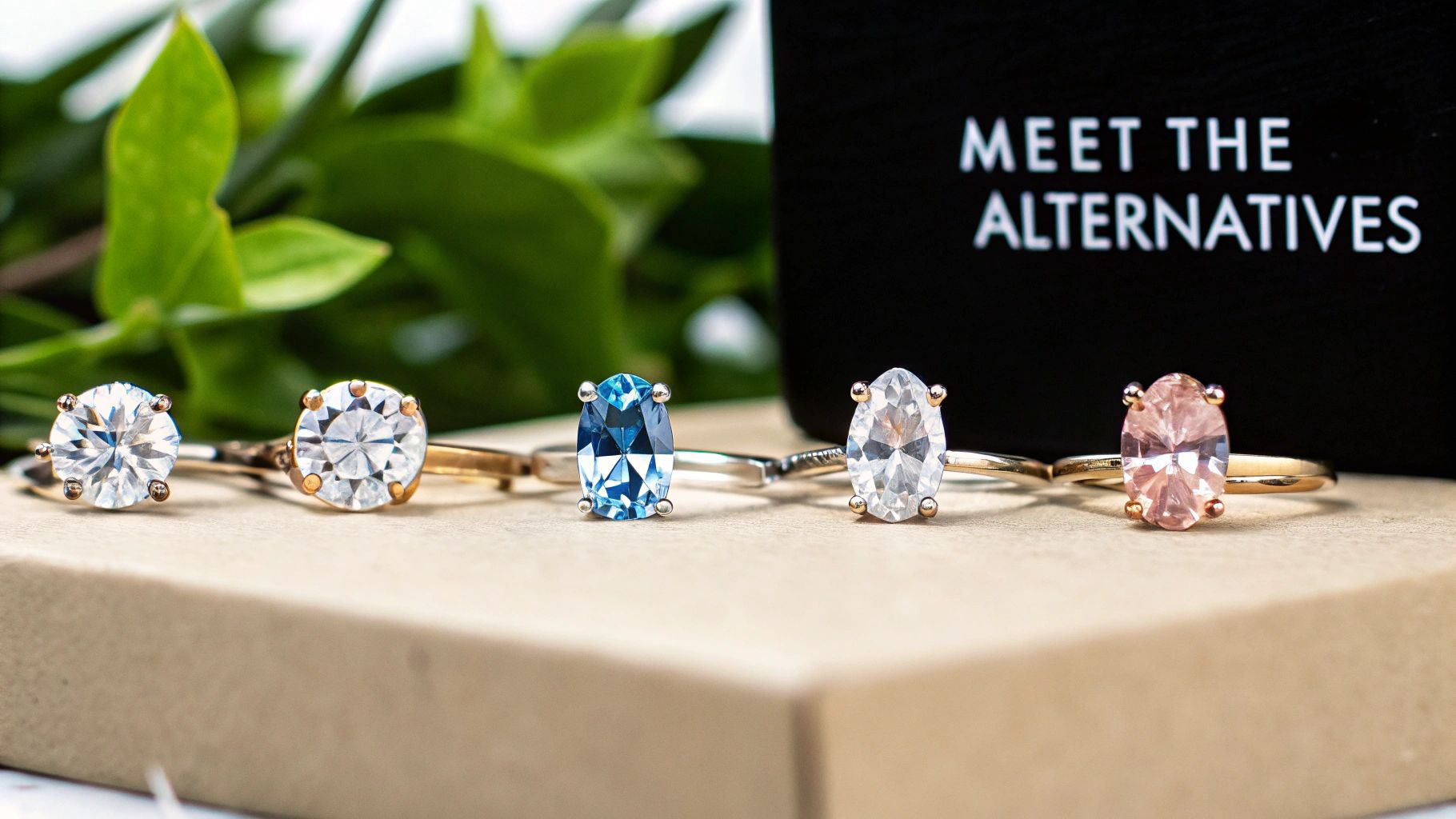
Shopping for diamond alternatives for engagement rings feels a lot like exploring a gallery, where every piece has its own personality. Each stone brings something different to the table—a unique backstory, a signature look, and a specific feel.
Let's get to know the top contenders. We’ll go beyond just their names and look at what really makes moissanite, lab-grown diamonds, sapphires, and morganite such fantastic choices for a modern ring. You'll learn what to expect from each one so you can find a stone that truly connects with your style.
Moissanite: The Brilliant Contender
Originally discovered in a meteorite crater, moissanite is literally a gem born from the stars. Since the natural stuff is incredibly rare, all the moissanite you see in jewelry today is created in a lab from silicon carbide. This gives us flawless quality and a stone you can feel good about wearing.
The real showstopper with moissanite is its sparkle. It has a higher refractive index than a diamond, which is a technical way of saying it bends light more intensely to create blinding brilliance. But its most famous trait is its “fire”—the ability to split light into a full-blown rainbow of colors.
Here’s an easy way to think about it: a diamond gives you a crisp, icy-white sparkle. Moissanite puts on a disco party, flashing with vibrant, fiery colors from every angle. It’s this rainbow effect that people absolutely fall in love with.
Ranking at a 9.25 on the Mohs scale of hardness, moissanite is one of the toughest substances on earth, second only to diamonds. That kind of durability makes it a perfect, worry-free choice for a ring you'll wear every single day.
As a bonus, moissanite is known for resisting oil and grime, which means it stays dazzling with less frequent cleaning. To get the full story, check out our deep dive on what moissanite is and why it's so popular.
Lab-Grown Diamonds: The Identical Twin
Let’s be crystal clear: a lab-grown diamond is a real diamond. It is not a "fake" or a simulant. It has the exact same chemical makeup, physical structure, and optical properties as a diamond that came out of the ground. The only thing that's different is its origin story.
Think of it like growing two identical roses—one grew wild in a field, and the other was nurtured in a high-tech greenhouse. They're both the same rose. Lab diamonds are created using technology that perfectly mimics the intense pressure and heat that forms diamonds deep within the Earth.
This means you get the same iconic brilliance and unmatched hardness (10 on the Mohs scale) you expect from a diamond, but with two massive perks:
- Price: Lab-grown diamonds typically cost 20-40% less than mined diamonds of the same size and quality.
- Ethics: They are guaranteed to be conflict-free and are a much more environmentally sustainable choice than traditional mining.
For anyone who loves the classic diamond look but cares deeply about budget and ethical sourcing, a lab-grown diamond is a no-brainer.
Sapphires: The Royal Classic
Sapphires have been a symbol of royalty for centuries, offering a timeless and elegant alternative to a clear stone. While they're famous for that deep, velvety blue, sapphires actually come in a whole rainbow of "fancy" colors—you can find them in pink, yellow, green, and even purple.
As part of the corundum mineral family, sapphires are exceptionally tough, hitting a 9 on the Mohs scale. This makes them one of the hardest natural gems out there and an amazing option for an engagement ring you’ll have on for life.
Choosing a sapphire is a great way to show off your personality. A classic blue feels wise and regal, while a bright pink sapphire gives off a modern, romantic vibe. There's even the rare and coveted padparadscha sapphire, with its stunning blend of pink and orange.
While the very best blue sapphires can get pricey, most of the beautiful colored varieties are surprisingly affordable compared to diamonds.
Morganite: The Romantic Newcomer
If you're drawn to softer, warmer colors, morganite has become an absolute favorite. It’s part of the beryl family (just like emeralds and aquamarines) and is loved for its gorgeous range of pale pink to peachy-pink tones.
This gem was only discovered in the early 1900s, but it didn't take long for it to become a go-to for its warm, feminine glow. The color really pops when it’s set in rose gold, creating a perfectly coordinated, romantic look.
Morganite is a durable stone, ranking between 7.5 and 8 on the Mohs scale. It’s definitely strong enough for daily wear, but you’ll want to be a little more mindful with it than you would a sapphire or moissanite to avoid scratches.
One of the biggest appeals of morganite is the price. It lets you get a much larger, more impressive stone for your budget, making it a beautiful and practical choice for a show-stopping ring.
How Hardness Impacts Everyday Wear
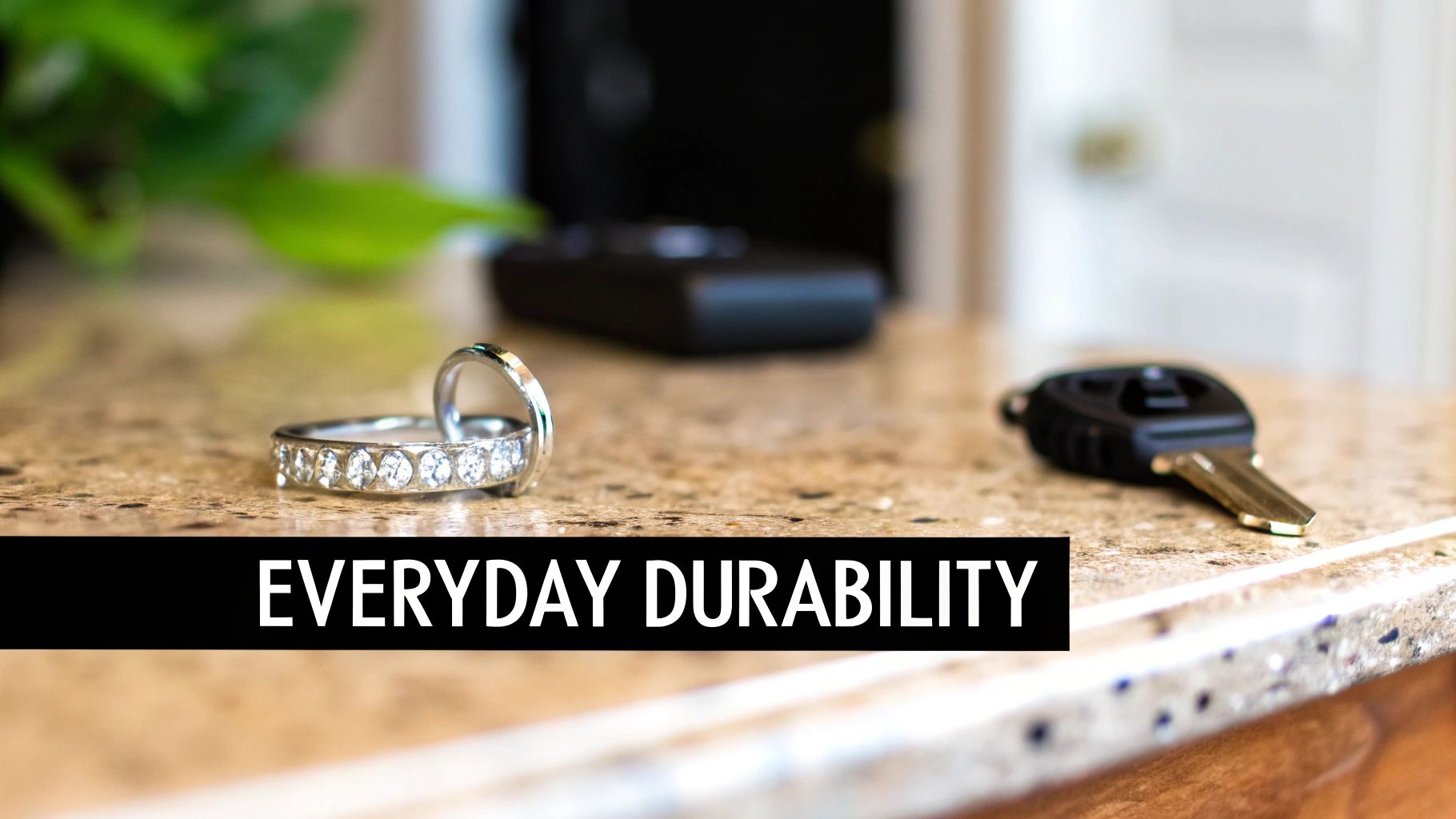
Think about it: an engagement ring is on your hand through everything. It’s there while you’re cooking, carrying groceries, opening doors, and living your life. This isn't just a piece of jewelry for special occasions; it's a constant companion meant to last a lifetime. That's why durability isn't a boring technical detail—it’s one of the most practical things to consider.
Everyday bumps and knocks are inevitable. A gemstone's hardness is the single best indicator of how well it will stand up to the unavoidable scratches and abrasions of daily life. A harder stone keeps its stunning, mirror-like polish for decades, while a softer one is more likely to show its age with surface wear.
Understanding the Mohs Scale
Jewelers measure this scratch resistance using the Mohs scale of hardness. It’s a straightforward 1-to-10 ranking system where a higher number means a tougher, more durable mineral. Pretty simple, right? Any mineral on the scale can scratch another mineral with a lower number.
A diamond, being the hardest natural substance we know of, scores a perfect 10. This is the benchmark for a ring you never have to take off. As a rule of thumb, anything rated 8 or above is an excellent choice for longevity. Stones rated 7 or higher can also work beautifully, they just require a bit more care.
So, how do the most popular diamond alternatives for engagement rings measure up?
- Moissanite: Comes in at an incredible 9.25, making it the second-hardest gemstone commonly used in jewelry. It’s exceptionally resistant to scratching and is absolutely built for a lifetime of wear.
- Sapphire & Ruby: Both members of the corundum family, these classic gems score a solid 9. Their fantastic durability is why they've been the choice of royalty for centuries.
- Cubic Zirconia (CZ): With a hardness of 8 to 8.5, CZ is definitely durable. However, it's more prone to scratches than moissanite or sapphire, and over many years, those tiny surface abrasions can give it a cloudy look.
- Morganite & Aquamarine: These stones, both from the beryl family, rank between 7.5 and 8. They’re certainly strong enough for an engagement ring, but they do require a little more mindfulness to avoid bumps against hard surfaces.
One crucial detail: the Mohs scale isn't like a ruler where the distance between each number is the same. The leap from a 9 (sapphire) to a 10 (diamond) is huge. In fact, a diamond is roughly four times harder than a sapphire.
Matching Hardness to Your Lifestyle
What do these numbers really mean for you? It’s all about matching the stone’s toughness to your daily routine. If you lead an active life, you need a gemstone that can handle the occasional knock without causing you a mini heart attack.
For instance, if you work with your hands, love gardening, or just tend to be a bit clumsy, a stone with a higher Mohs rating like moissanite or sapphire is a fantastic, worry-free choice. These gems offer serious peace of mind, ensuring your ring stays brilliant and flawless through years of real-world wear.
A stone's hardness is directly tied to its ability to stay sparkly. Scratches on a gem’s surface ruin the way light bounces around inside, making it look dull. That's why a higher Mohs rating is essential for a brilliance that truly lasts.
Softer stones like morganite are gorgeous, but they're better suited for someone who is naturally careful with their jewelry or has a less hands-on daily schedule. You can also give them a boost with a protective setting, like a bezel or a halo, which helps shield the stone. If you're still weighing the pros and cons, our guide on moissanite versus lab-grown diamonds versus cubic zirconia breaks down even more of the details.
Navigating Sparkle, Cost, and Ethics
When it comes to picking an engagement ring, the decision usually boils down to three big questions: How does it sparkle? What does it cost? And what’s the story behind it? Getting a handle on these key factors is the secret to finding a diamond alternative that doesn't just look incredible but also feels right.
Let’s break down these three pillars—sparkle, budget, and ethics. Think of them as a balancing act. The choice you make in one area will almost always affect the others, helping you land on a decision that truly reflects who you are as a couple.
Decoding the Sparkle Factor
"Sparkle" isn't a single thing; it's really a one-two punch of how a gemstone handles light. The two terms you need to know are brilliance and fire.
Here’s a simple way to think about it:
- Brilliance is that classic, bright white light that shoots right back at you. Picture a flawless mirror catching the sun—that’s brilliance. It’s what gives diamonds their famous icy, crisp look.
- Fire is the explosion of rainbow colors you see when the stone moves. This happens when the gem acts like a tiny prism, splitting white light into a whole spectrum of colors.
Moissanite’s unique crystal structure is doubly refractive, which is a fancy way of saying it bends and splits light beams far more dramatically than a diamond. The result is its signature, over-the-top, disco-ball fire. While a diamond gives you a sophisticated mix of white and colored light, moissanite goes all-in on that intense rainbow flash—a vibrant, dazzling personality that many people absolutely fall in love with.
Making Your Budget Work for You
Let's be honest: the price difference between mined diamonds and their alternatives is a massive driver for couples exploring other options. This isn't about being cheap; it's about being smart with your money and getting more for it. Choosing an alternative means you can often afford a larger, more impressive stone without the years of financial regret.
Let's run the numbers with a realistic budget of $3,000 for just the center stone.
| Gemstone Option | What You Can Expect for $3,000 |
|---|---|
| Mined Diamond | A high-quality stone right around 0.75 carats. |
| Lab-Grown Diamond | A gorgeous, high-quality stone between 1.5 to 2.0 carats. |
| Moissanite | A huge, flawless stone of 3.0 carats or more, likely with cash to spare for a fancier setting. |
Seeing it side-by-side makes the value proposition impossible to ignore. With diamond alternatives for engagement rings, your budget stretches so much further. It puts you back in control, letting you choose the size and style you actually want, not just what the traditional market says you can afford.
The Ethical Advantage of Lab-Created Gems
An engagement ring is a symbol of your love story, and for more and more couples, that story needs to be a clean one. The history of diamond mining is unfortunately tangled up with environmental devastation and human rights abuses, leading to the term "blood diamonds" or "conflict diamonds."
The industry has tried to clean up its act with programs like the Kimberley Process, but traceability is still a huge hurdle. It's often next to impossible to be 100% certain of a mined diamond's true origin story.
This is where lab-created gems offer total peace of mind. A stone grown in a clean, controlled environment simply doesn't have any ethical baggage. There’s no conflict, no questionable labor, and a dramatically smaller environmental footprint.
Choosing a lab-grown diamond or moissanite means your ring is a pure symbol of your commitment, completely untainted by ethical worries. For many people today, making that conscious choice is a powerful statement.
This isn't just a niche trend; it's fundamentally reshaping the jewelry industry. The moissanite market alone was valued at $85.2 million in 2021 and is expected to hit $106.3 million by 2025. That 24.9% jump is being fueled by Millennials and Gen Z, who consistently put their money where their values are by choosing sustainable and ethically sourced products. You can read more about the growth of the moissanite market and see the data for yourself.
A Practical Checklist for Choosing Your Ring
Alright, you've gotten the rundown on the main players in the world of diamond alternatives for engagement rings. Now, let's turn all that information into a decision you can feel great about. This isn't just about picking a pretty stone; it's about finding one that fits your life, your budget, and your story.
This simple checklist will walk you through the final steps, helping you nail down what truly matters to you so you can choose a ring you'll love for a lifetime.
Define Your Personal Priorities
First things first: what's most important to you and your partner? There are no wrong answers here. It's all about what feels right for you.
- What does your daily life look like? If you're constantly on the go, work with your hands, or have active hobbies, you'll want a stone that can keep up. Something tough like moissanite (9.25 on the Mohs scale) or a sapphire (9) is a brilliant, worry-free choice.
- How much sparkle are you after? Do you prefer the classic, white-light brilliance of a diamond? Or does the fiery, rainbow flash of a moissanite catch your eye? The best way to know is to watch videos of each side-by-side.
- What values matter to you? If knowing exactly where your stone came from is a top priority, lab-created gems are the way to go. Moissanite and lab diamonds give you that peace of mind with a guaranteed conflict-free origin.
- Want to add a splash of color? Don't forget that an engagement ring can be a perfect expression of personality. A stunning deep blue sapphire or a soft, romantic pink morganite can make your ring feel incredibly personal and unique.
This decision tree can help you see which stone aligns best with what you care about most, whether it's fire, cost, or ethics.
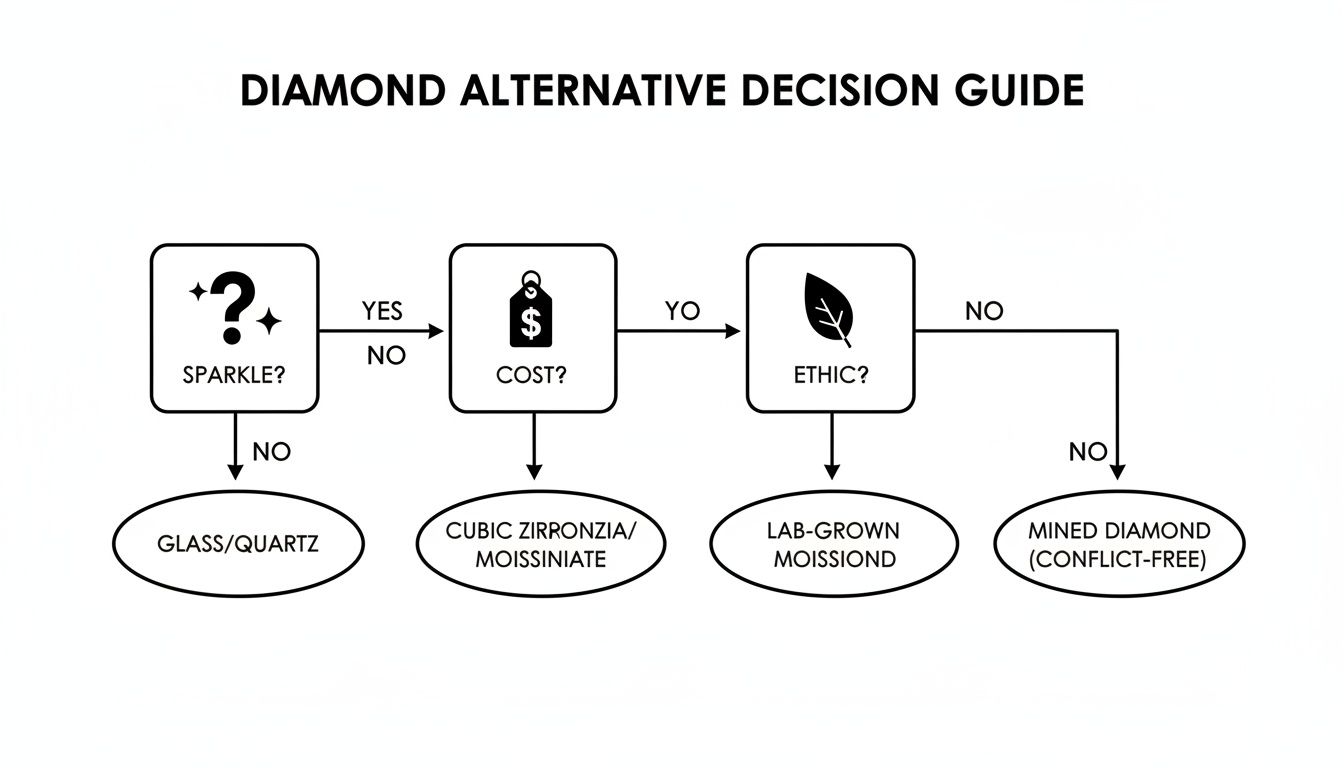
As you can see, prioritizing different factors can lead you down different paths, but each one ends with a beautiful, meaningful choice.
Verify the Technical Details
Once you have a good idea of the type of stone you want, it’s time to zoom in on the specifics. Getting these details right is what separates a good purchase from a great one.
A beautiful ring is more than just a stone; it's the sum of its quality, craftsmanship, and the guarantee that stands behind it. Don't skip these crucial final checks.
Here’s what to look for before you commit:
- Understand the "4Cs" for Your Stone: The 4Cs—Cut, Color, Clarity, and Carat—aren't just for diamonds. They apply to most gems, and the cut is the most important factor for bringing out the sparkle in any stone. A well-cut stone will always outshine a poorly cut one, regardless of its other specs.
- Ask for Certification: If you're buying a lab-grown diamond, insist on seeing a grading report from a reputable lab like GIA or IGI. This is your independent proof of the stone's quality.
- Review the Retailer’s Policies: Make sure the jeweler has a clear and fair return policy. You'll want a reasonable amount of time, like 30 days, to see the ring in person and be absolutely sure it's the one.
- Check the Warranty: A solid warranty that covers manufacturing defects is a sign that the jeweler stands behind their work. It's your long-term protection and peace of mind.
Caring for Your Diamond Alternative Ring
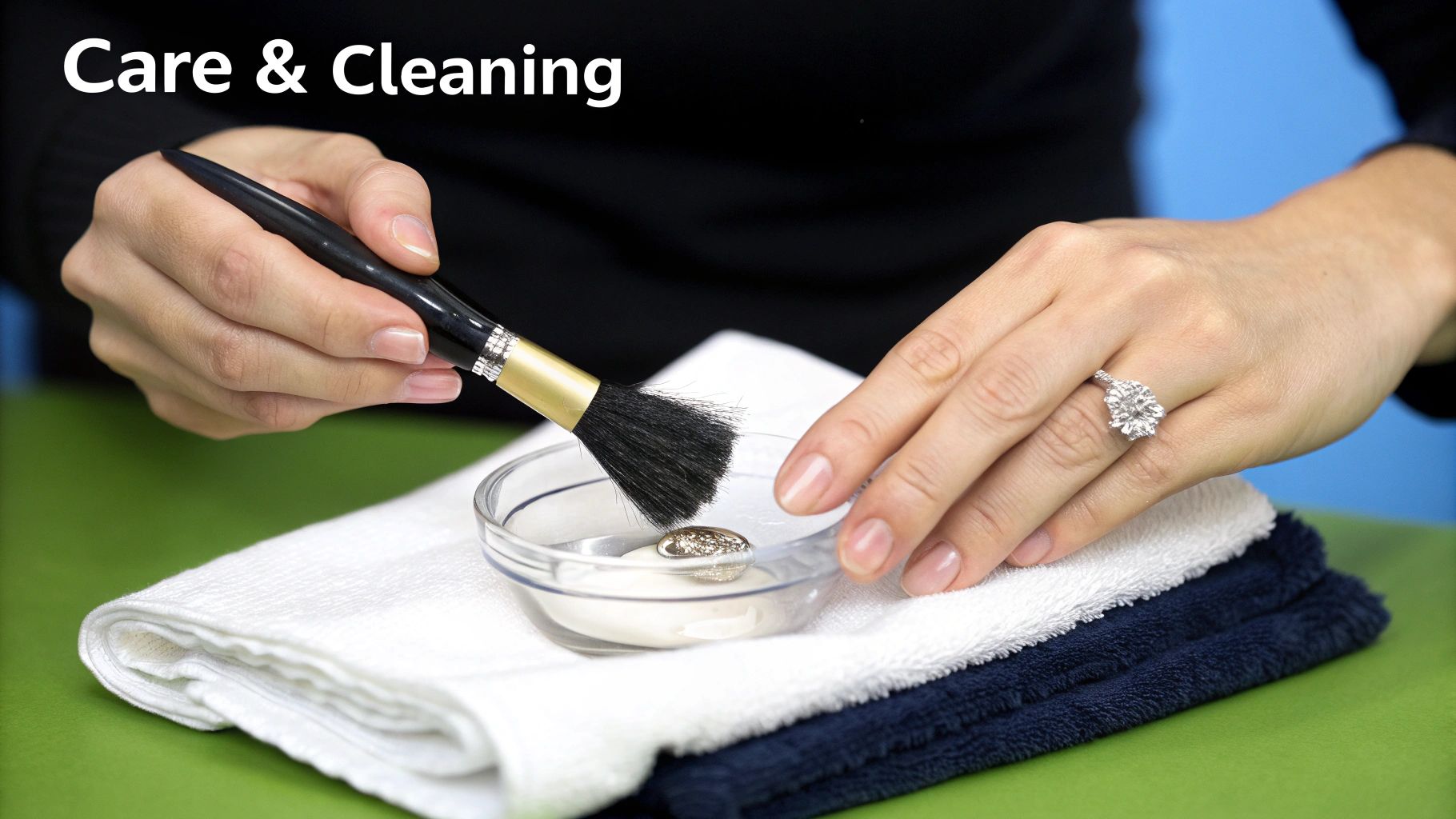
An engagement ring is something you wear every day, a constant reminder of a special commitment. Keeping that symbol looking its best is actually pretty straightforward. While different diamond alternatives for engagement rings have their own quirks, a few simple habits apply across the board and will keep your ring beautiful for decades.
A good rule of thumb is to make your ring the last thing you put on in the morning and the first thing you take off at night. Lotions, hairspray, and perfumes are notorious for building up a grimy film that completely kills a gemstone's sparkle. You should also always take your ring off before doing anything that could expose it to harsh chemicals or physical damage.
Be sure to remove your ring:
- Before hitting the gym or playing sports to avoid knocks and bumps.
- When swimming in a pool or hot tub, as chlorine can be brutal on precious metals.
- Before you start cleaning with strong chemicals like bleach or ammonia.
- During hands-on tasks like gardening, moving furniture, or cooking.
Making this a habit is the single best thing you can do to protect your ring and keep the stone from coming loose.
Gemstone-Specific Cleaning Tips
While the daily-wear rules are universal, how you clean your ring really depends on the stone itself. Each gem has a different level of toughness, so a one-size-fits-all cleaning method is a recipe for disappointment.
The whole point of cleaning your ring is to gently lift away the daily buildup of skin oils, soap, and dirt without harming the gem or its metal setting. When in doubt, always start with the gentlest method.
For the tougher stones out there, like moissanite and sapphires, a simple home cleaning solution works wonders. Just mix a few drops of mild dish soap into a bowl of warm water. Let the ring soak for about 20-30 minutes to loosen any grime.
After it has soaked, use a super-soft toothbrush to gently scrub around the stone, especially underneath where gunk loves to hide. Rinse it well under clean water and pat it dry with a soft, lint-free cloth.
Softer gems like morganite need a much lighter touch. You can still use the same mild soap and water mixture, but you should avoid any real scrubbing. A quick dip and a gentle wipe-down with a soft cloth is all it needs. And whatever you do, never put delicate stones like morganite or emerald into an ultrasonic or steam cleaner—the intense vibrations and heat can cause serious damage.
A Few Final Questions About Diamond Alternatives
Even after doing your homework, a few questions can pop up when you're navigating the world of diamond alternatives for engagement rings. Let's clear up some of the most common ones so you can feel completely confident in your choice.
Will People Know My Moissanite Ring Isn't a Diamond?
Honestly, probably not. To the naked eye, moissanite and diamond look incredibly similar. A trained jeweler using a loupe can spot the difference, of course, but your friends and family won't.
The biggest giveaway is actually moissanite's signature sparkle. It throws off more fiery, rainbow-colored flashes of light than a diamond. Many people don't see this as a dead giveaway but as a beautiful feature in its own right—they actually prefer that extra "disco-ball" effect.
Are Diamond Alternatives a Good Investment?
Here's the truth: an engagement ring, regardless of the stone, isn't a traditional financial investment like stocks or real estate. Even natural diamonds, often marketed as an investment, have a notoriously poor resale value, and you'll almost never get back what you paid.
The real financial win with a diamond alternative is the money you save upfront. You get a gorgeous, durable ring for a fraction of the cost, which means you can put thousands of dollars toward a down payment, a honeymoon, or paying off debt.
The "return on investment" is the daily joy the ring brings you, not its potential resale price.
Isn't a Lab Diamond the Same as Moissanite?
Not at all—they are completely different gemstones. Think of it this way: a lab-grown diamond is chemically and physically identical to a mined diamond. Same material, different origin.
Moissanite, on the other hand, is a diamond simulant. It’s made from a different mineral (silicon carbide) that’s engineered to look like a diamond. It stands in a class of its own because it’s far more brilliant and durable than other simulants like Cubic Zirconia, making it a top-tier alternative, not just a cheap copy.
Ready to find a ring that’s as smart and unique as your love story? Explore the stunning, ethically sourced collections at Moissanite Diamond and see the brilliance for yourself. Find your dream ring today.